Some links on this page are affiliate links: as an Amazon Associate this site earns from qualifying purchases, and it may earn from other retail partners, at no extra cost to you.
Parts shown are general references, not specific endorsements. Match any part to your unit's
make, model, and spec before buying.
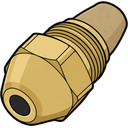
Oil burner nozzle
Atomizes the oil into a fine spray for combustion. It is sized by flow rate (GPH), spray angle, and pattern, so the replacement has to match the burner's spec exactly.
Replace it when: Every tune-up, and any time the flame is sooty or smoky or the burner will not light cleanly.
Often replaced at the same visit: pump strainer (in the tune-up kit), oil filter, cad cell
A thin wall wrench with a 5/8 inch and a 3/4 inch end that holds the nozzle adapter while the nozzle turns.
Why it earns its place: Two open end wrenches twist the oil line and crack the adapter. The right wrench changes a nozzle in a minute without moving the electrodes.
A stamped gauge that sets the gap between the electrode tips, and their height and distance ahead of the nozzle, to the settings the burner manual gives.
Why it earns its place: Electrode settings are tenths of an inch. The gauge makes them the same on every burner; a ruler does not.
A 0 to 300 psi gauge that threads into the port on the fuel pump. It reads the pressure the nozzle is fed at.
Why it earns its place: Pump pressure is the second number the nozzle chart needs. Pressure sets the firing rate as much as the nozzle does.
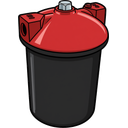
Oil filter and cartridge
Catches sludge and water before they reach the pump and nozzle. The cartridge is a routine wear item changed at every tune-up.
Replace it when: Every tune-up, after a run-out, or whenever the burner starves for fuel.
Often replaced at the same visit: nozzle, pump strainer (in the tune-up kit), oil safety valve
Common: General 1A-25 cartridge, General 2A-700 spin-on
Oil filter and cartridge: how it works and what to buy →
The annual wear set a tune-up replaces together: nozzle, oil filter cartridge, cad cell, electrodes, and pump strainer gasket.
Replace it when: Once a year, before the heating season starts.
Often replaced at the same visit: nozzle, oil filter, primary control
A sheet of oil-only sorbent laid under the burner, filter, and pump. It catches the drips from a filter change, a bleed, or a weeping fitting before they soak into the floor and leave the boiler room smelling of oil.
Replace it when: Whenever a pad is saturated or you can smell oil near the burner. Put a fresh one down before a filter change or a bleed, and keep a pack on the shelf.