Oil burners by brand
The common residential oil burners in North America come from four makers: Beckett, Carlin, Riello and Wayne. Each brand page decodes that burner's control lights and lockout codes, lists the setup specs from the manuals, shows the electrode settings and links the part numbers. If you do not know the brand, match the burner to a card below. The name is usually printed on the housing or on the control cover. New to the burner itself? Start with how an oil furnace works.
Setup framework (applies to most gun burners)
The numbers that set up a conventional gun burner, and what differs by brand. Every value is sourced to a manual. Nozzle size, spray angle and pattern, and air are matched to the appliance rating plate and tuned with an analyzer, not read off a universal number, so confirm against the plate and the manual for your exact equipment.
Nozzle rating basis
Oil nozzles are rated in gallons per hour (GPH) at 100 psi pump pressure. Match the nozzle GPH, spray angle (about 30 to 90 degrees), and pattern (hollow, solid, or semi-solid) to your appliance's rating plate, not to the burner alone.
Source: NORA Oil Heat Technicians Manual, ch 05 (Nozzles); cross-checked against Slant/Fin and Wayne nozzle tables (both rated at 100 psi)
Pump pressure
Conventional high-pressure gun burners run roughly 100 to 150 psi. Never operate below 100 psi, low pressure wrecks atomization. The exact setting comes from the appliance and burner spec.
Source: NORA Oil Heat Technicians Manual, ch 05 (Nozzles): rated at 100 psi, higher pressures recommended by many manufacturers, never below 100 psi
Electrode gap and position
Set the electrodes per the manufacturer's instructions for your burner. NORA's typical conventional figures are about a 5/32 inch spark gap, 5/16 inch above the nozzle center line, and 1/16 inch ahead of the nozzle face. Gaps differ by burner, so confirm yours.
Source: NORA Oil Heat Technicians Manual, ch 12 (Ignition Systems) and ch 15 (Service Procedures)
Cad cell flame proving
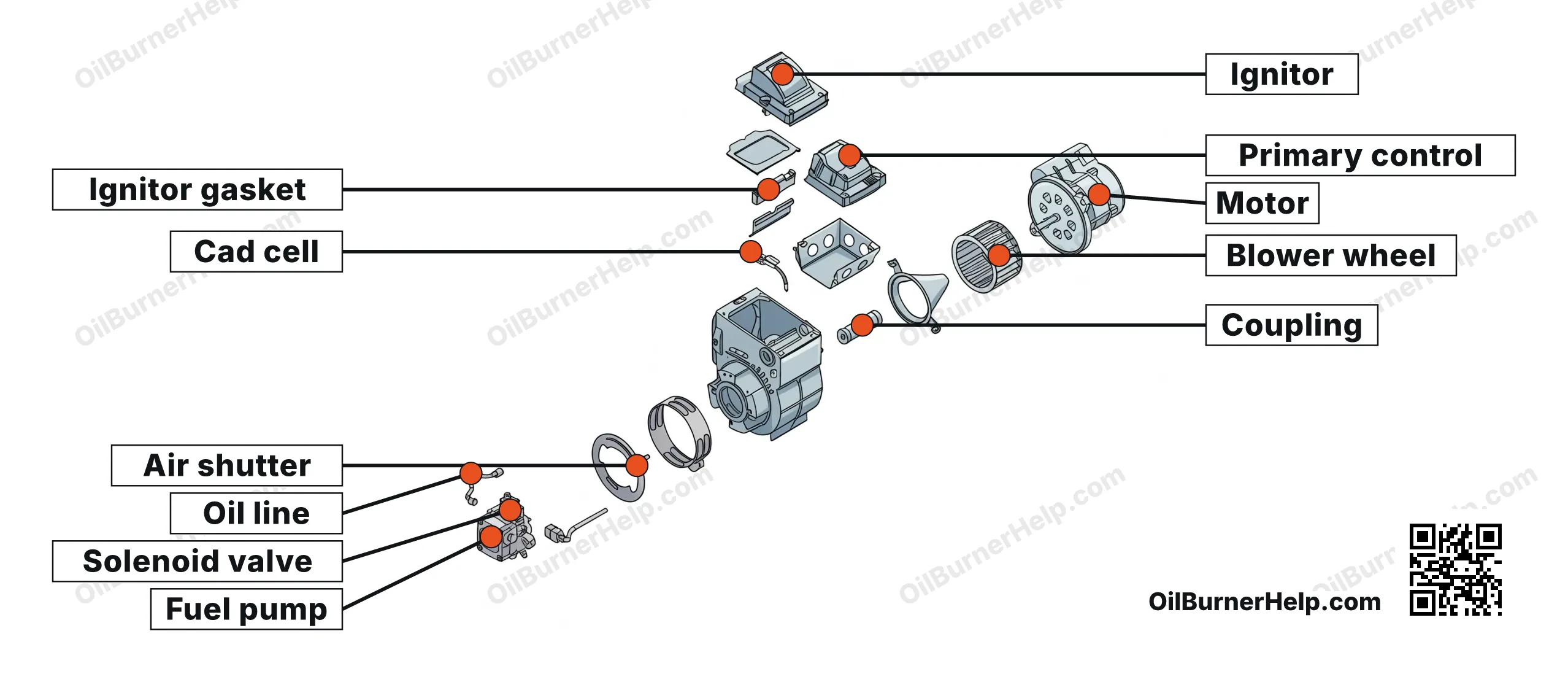
A healthy cad cell reads low resistance when it sees flame (a strong signal); high resistance means it cannot prove flame and the primary control locks out. Clean or re-aim a sooted cell before replacing it.
Source: NORA Oil Heat Technicians Manual, ch 10 (Primary Controls)
Combustion tuning targets
Source: NORA Oil Heat Technicians Manual, ch 07 (Combustion) and ch 14 (Annual Maintenance)
Where to go next
https://oilburnerhelp.com/burners/