How does an oil furnace or boiler work? The full system
Updated 18 Oct 2026
Quick answer
Here is how an oil furnace works: its burner sprays a fine mist of heating oil into a combustion chamber, lights it with a high-voltage spark, and blows or pumps the heat into your home, all supervised by a control that proves a real flame exists before it keeps feeding oil. Understanding that sequence is what makes every no-heat symptom make sense.
On this page 5 sections
The system, part by part
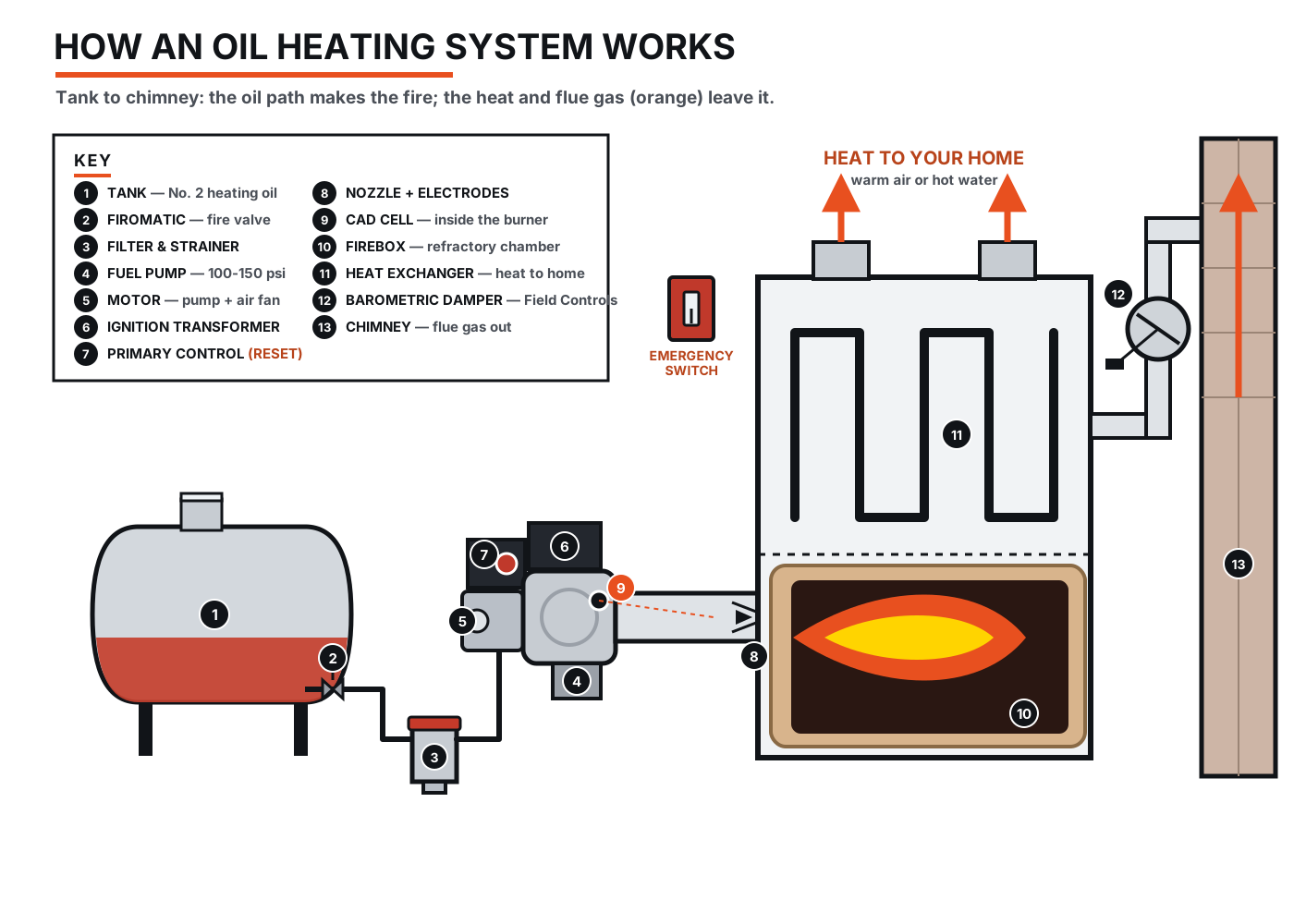
An oil heating system is a handful of parts doing one job: turn a tank of oil into even heat, safely. From the tank to the chimney:
- The tank stores No. 2 heating oil and feeds it through a suction linesuction lineThe oil line the pump draws fuel through from the tank. An air leak here causes hard starts and lockouts. to the burner.
- The filter and strainerstrainerA mesh filter inside the fuel pump that catches debris. It is cleaned or replaced as part of a tune-up. catch sludge and water before they reach the moving parts.
- The fuel pump pulls oil from the tank and pressurizes it, usually to around 100 to 150 psi.
- The nozzlenozzleThe precision tip that atomizes oil into a fine spray for burning. It is sized by flow rate, spray angle, and pattern. atomizesatomizeTo break oil into a fine mist so it burns cleanly. The nozzle does this under pump pressure. that pressurized oil into a fine, cone-shaped mist sized to the burner.
- The electrodeselectrodesThe pair of ceramic-insulated rods that arc a high-voltage spark to light the oil spray. arc a spark from the ignition transformer or igniter to light the mist.
- The cad cellcad cellThe light sensor that proves a flame is burning. If it cannot see flame fast enough, the primary control locks the burner out. watches the fire and tells the primary controlprimary controlThe small box on the burner that runs the ignition sequence, watches the cad cell, and latches into lockout on a failed start. whether a flame really exists.
- The primary control runs the whole sequence and shuts everything down if it cannot prove flame.
- The heat exchangerheat exchangerThe metal chamber that passes combustion heat into your home's air or water while keeping the fumes separate. A crack in it is a carbon monoxide hazard. passes the fire’s heat into your home’s air or water while keeping the fumes separate, and the barometric damperbarometric damperThe hinged flue damper that steadies draft over the burner by letting in room air when the chimney pulls too hard. and chimney carry those fumes away.
What happens on a call for heat
When the thermostat calls, the primary control runs a fixed sequence, the same one on a Beckett GeniSysGeniSysBeckett's modern oil primary control. It reports its state with status lights (red, green, yellow) rather than a blink count. or a Honeywell R7184R7184A Honeywell/Resideo oil primary control. One light shows its mode by flash rate, and a separate flash count reads the cad cell's strength., just with different timings:
- Start. The burner motor spins up the fuel pump and the combustion-air fan, and the ignition begins. Some controls add a short valve-on or pre-purge delay first.
- Trial for ignition. The pump pushes oil through the nozzle, it atomizes into a cone, and the electrodes spark to light it. The control gives this a fixed window, typically 15 to 45 seconds, to produce a flame.
- Proving the flame. The cad cell has to see steady light within that window. If it does, the control settles into the run cycle. If it does not, the control shuts the burner down and latches into lockoutlockoutThe safety state the primary control latches into after a failed start. It stops the burner until someone presses reset. rather than keep spraying oil.
- Run. The fire heats the heat exchanger. On a furnace a blower sends warm air through ducts once the exchanger is hot; on a boiler a circulator moves heated water to baseboards or radiators.
- Satisfied. When the thermostat is satisfied (or a limit is reached), the burner stops. The blower or circulator may run on a bit longer to wring out the stored heat.
That flame-proving step is the heart of it. An oil burner is mostly a very disciplined way of making sure a fire is actually burning before it keeps feeding fuel to it.
Furnace or boiler? Same fire, different delivery
- A furnace heats air and blows it through ducts and registers. “Blowing cold air” problems live here. See furnace blowing cold air.
- A boiler heats water for baseboard, radiators, or radiant floors, and often makes your hot water too (see hot water from an oil boiler).
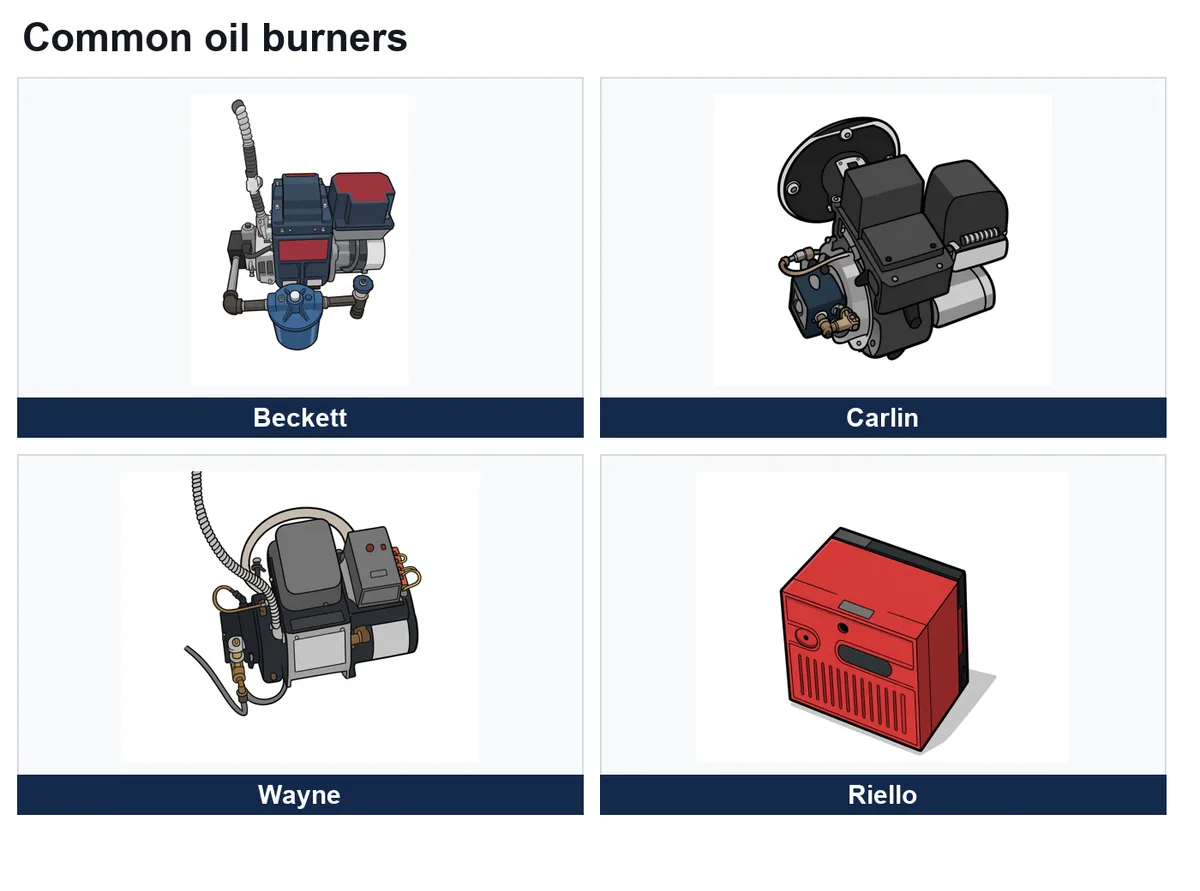
- The burner on the front is nearly identical either way, which is why the troubleshooting is mostly the same.
Where it goes wrong (and where to read next)
Because the sequence is fixed, every common symptom maps to a step:
- Nothing starts: power, thermostat, switches, or fuel. See not turning on.
- Locks out: the flame was never proven. See the reset button and fires then shuts off.
- Ran dry: air in the line breaks the fuel step. See ran out of oil.
The full decision chart ties them together, and the parts by symptom page shows the component behind each fault.
A few honest notes
- Oil systems are simple and long-lived, which is their real advantage. A well-tuned burner is nearly odorless and efficient; most trouble is deferred maintenance, not a design flaw. A yearly tune-up keeps the sequence above running clean.
- No. 2 heating oil carries about 138,500 BTU per gallon, which is why a single gallon does so much work and why a small efficiency gain adds up over a winter (see the oil usage estimator).
Sources
- R.W. Beckett residential burner operation literature
- Honeywell/Resideo primary control sequence-of-operation documentation
- U.S. EIA heating fuels documentation