Oil furnace troubleshooting chart: what to check, in order
Updated 18 Oct 2026
Quick answer
Troubleshooting an oil furnace or boiler starts with the list, in order: thermostat set and calling, the emergency switch and the service switch both on, breaker, oil in the tank, reset button pressed ONCE. If heat isn't back after those five checks, stop. The remaining causes (fuel delivery, ignition, flame sensing) need a technician's instruments. Strong oil smell, smoke, or a CO alarm ends the checklist immediately: shut down and call.
On this page 7 sections
Before anything: two situations that end the checklist
Stop and skip straight to a phone call if either is true:
- Strong oil smell or smoke. Shut the burner off at the service switch and call. Do not keep trying to start it. See oil furnace smells.
- A CO alarm, or headache, nausea, or grogginess that improves outdoors. Carbon monoxide has no smell. Leave the house first, then call from outside.
Everything below assumes the air is clear and nothing smells of oil or smoke.
The five-minute homeowner checklist, in order
These are the safe, no-tools checks that resolve a large share of no-heat calls. Do them in this order.
- Thermostat. Heat mode, setpoint five degrees above the room. Change the batteries if it takes them. A new smart thermostat on an oil system can be underpowered without a C wire (see the thermostat guide).
- The emergency switch and the service switch. The burner switch at the unit, and the red emergency switch at the top of the basement stairs that looks like a light switch. One of them off kills the burner with no other symptom.
- Breaker or fuse for the burner circuit. ResetresetThe button that clears a lockout for one more ignition attempt. Press it once only, never repeatedly. once. If it trips again, stop. That is a fault, not a nuisance trip.
- Oil level, for real. Do not trust the float gauge (read the gauge explains why a stick beats it). Stick the tank and convert with the tank chart. Below an eighth, order oil first.
- Reset button, once. If the primary controlprimary controlThe small box on the burner that runs the ignition sequence, watches the cad cell, and latches into lockout on a failed start.’s reset is lit, press it a single time and watch a full cycle. If it locks out again, stop. The reset button guide explains why a second press is the wrong move.
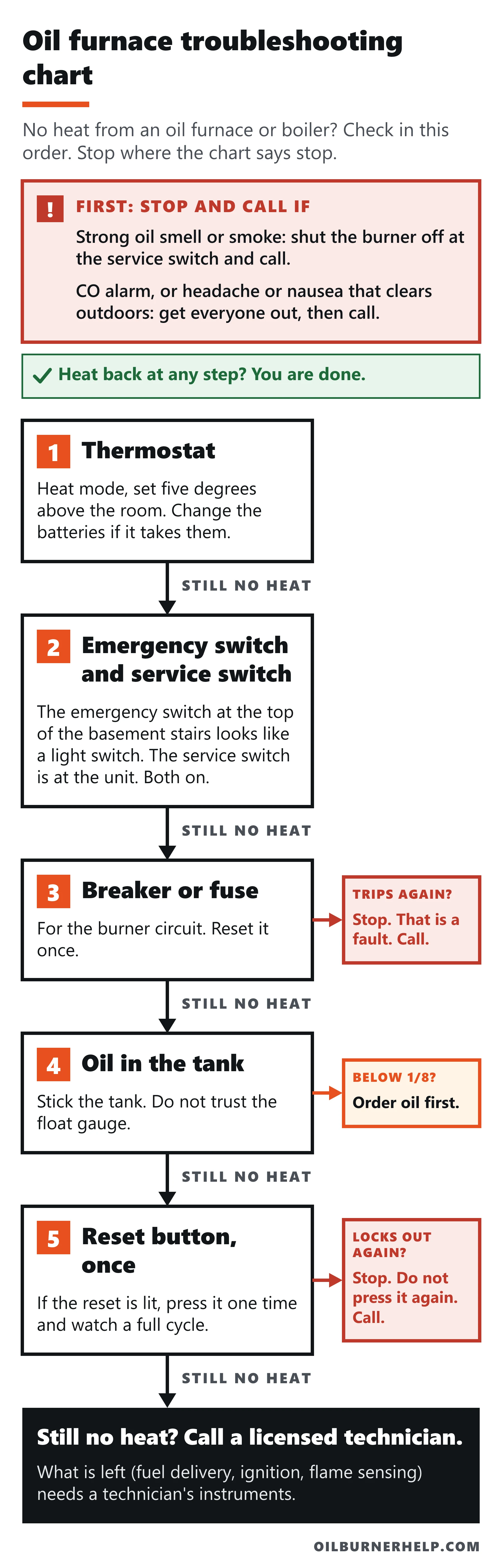
If heat is back, you are done. If not, match your symptom below.
Troubleshooting chart: match your symptom
Start with the matching guide
| Your symptom | What it usually means | Start here |
|---|---|---|
| Nothing happens at all | Power, thermostat, switches, or a dead tank. | |
| Locks out, reset relights it then it quits | Fuel, spark, or flame-proving fault. | |
| Fires, runs seconds to a minute, dies | Flame not proven (cad cell, nozzle, spark). | |
| Ran the tank empty | Airlock and sludge in the line. A tank that weeps or smells is on borrowed time. | |
| Blower runs, air is cold | The blower is running but the burner is not making heat. | |
| The control shows a code or blink pattern | The primary control is reporting what it is doing; the patterns differ by model. |
Stop and call, do not keep trying to start it
| Your symptom | What it usually means | Start here |
|---|---|---|
| Oil smell, smoke, or soot | Combustion fault, possible CO or puffback. |
|
Not the burner
| Your symptom | What it usually means | Start here |
|---|---|---|
| Runs fine but rooms stay cold | On a boiler, a zone valve or circulator, not the burner. |
|
| Heat works, no hot water (boiler) | A tankless coil inside the boiler or a separate indirect tank makes the hot water. |
What the symptom tells the technician (and why you stop here)
A lockoutlockoutThe safety state the primary control latches into after a failed start. It stops the burner until someone presses reset. means the control could not prove flame, and that traces to one of three families: no fuel reaching the fire (filter, pump, air leak, sludge), fuel but no spark (electrodeselectrodesThe pair of ceramic-insulated rods that arc a high-voltage spark to light the oil spray., igniterigniterThe modern solid-state replacement for the ignition transformer, doing the same job of firing the spark., transformer), or fire but no proof (cad cellcad cellThe light sensor that proves a flame is burning. If it cannot see flame fast enough, the primary control locks the burner out., flame quality). A technician sorts these with gauges and meters, not guesses: pump pressure and vacuumvacuumThe suction the pump pulls on the line. A technician measures it to find a clogging filter or an air leak., electrode gap, cad cell resistance, draftdraftThe suction the chimney pulls through the burner. Too much or too little shows up as sooting, odor, or lost efficiency., and a combustion testcombustion analyzerThe instrument a technician uses to read the flue gases and tune the burner to spec. The part of a tune-up that cannot be eyeballed. to set the burner back to spec. We explain each of these on the linked pages, but the rule is the same: anything that needs an instrument or sets combustion is the tech’s, and the combustion test in particular is the part that cannot be eyeballed. The parts behind these faults page shows what each component is.
What the likely fixes cost
- Service call or diagnostic: roughly $100 to $250, often credited to the repair.
- Common parts are cheap: nozzlesnozzleThe precision tip that atomizes oil into a fine spray for burning. It is sized by flow rate, spray angle, and pattern., filters, and cad cells are tens of dollars; with labor a typical lockout fix lands around $150 to $400.
- Bigger parts: a pump, igniter, or transformer runs more like $200 to $450 installed. See the tune-up guide for what routine service covers, and the replacement cost guide for when a unit is past repair.
Prevent the 6 a.m. no-heat call
- A yearly tune-up replaces the parts that cause most lockouts before the season starts.
- Do not let the tank fall below a quarter in winter.
- A treatment additive helps control the sludge and water in the oil tank that feed run-out and fuel oil filter problems.
Parts behind this fault
Some links on this page are affiliate links: as an Amazon Associate this site earns from qualifying purchases, and it may earn from other retail partners, at no extra cost to you. Parts shown are general references, not specific endorsements. Match any part to your unit's make, model, and spec before buying.
- Oil absorbent padsA sheet of oil-only sorbent laid under the burner, filter, and pump. Check price on Amazon
- Oil filter and cartridgeCatches sludge and water before they reach the pump and nozzle. Check price on Amazon
- Oil fuel pumpPulls oil from the tank and pressurizes it to the nozzle. Check price on Amazon
- Fuel oil de-aeratorPurges air from the oil line so a one-pipe system self-bleeds after a run-out instead of locking out on air. Check price on Amazon
The other 9 parts a technician reaches for on this fault, with what each does and when it gets replaced: all oil burner parts by symptom.
Sources
- R.W. Beckett AFG burner manual
- Honeywell/Resideo R7184 primary control documentation
- NFPA 31: Standard for the Installation of Oil-Burning Equipment