Heating oil vs diesel vs kerosene: is it the same fuel?
Updated 18 Oct 2026
Quick answer
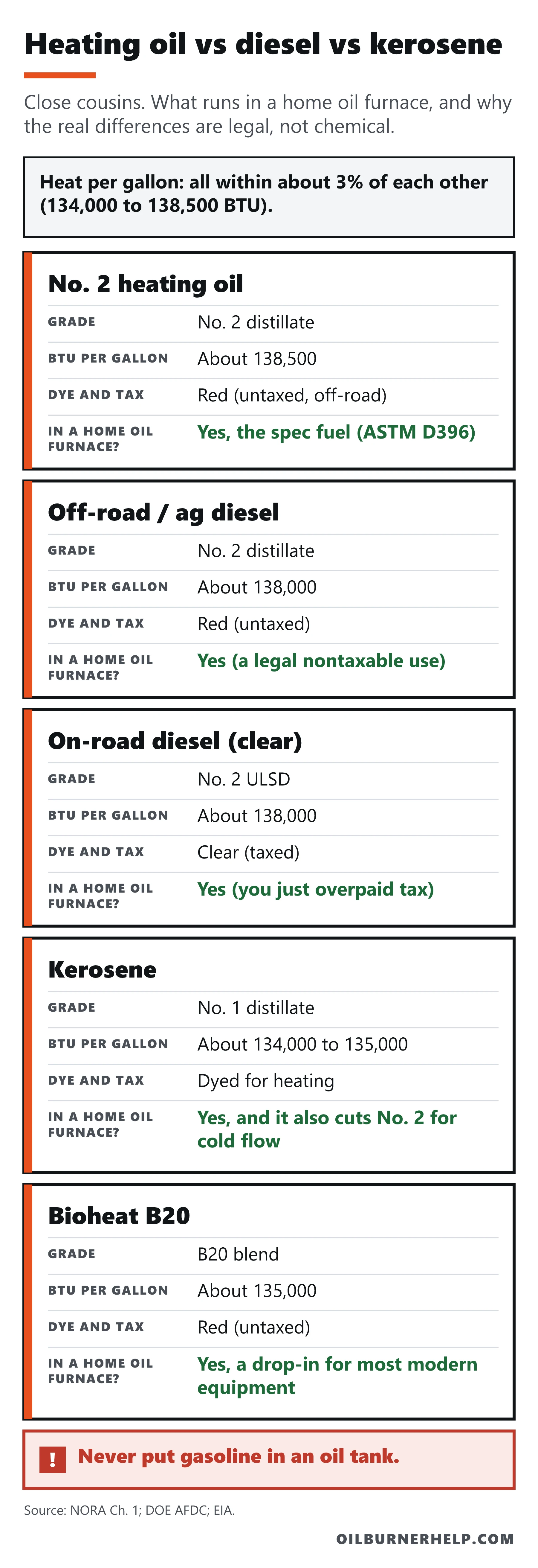
Heating oil, off-road diesel, and on-road diesel are all No. 2 distillates and very similar; kerosene is lighter No. 1 oil. Most oil furnaces will burn any of them short-term, and kerosene is a common cold-weather cut. The catches are legal, not chemical: red-dyed heating oil and off-road diesel are untaxed and illegal to burn in an on-road vehicle, and modern diesel engines need ultra-low-sulfur fuel.
On this page 7 sections
Bioheat here means the registered heating-fuel blend (biodiesel plus heating oil). This page separates what is technically true from what is legal: never put untaxed (dyed) fuel in a vehicle driven on public roads.
The fuels at a glance
| Fuel | Grade | BTU per gallon | Dye and tax | In a home oil furnace? |
|---|---|---|---|---|
| No. 2 heating oil | No. 2 distillate | About 138,500 | Red (untaxed, off-road) | Yes, the spec fuel (ASTM D396) |
| Off-road / ag diesel | No. 2 distillate | About 138,000 | Red (untaxed) | Yes (a legal nontaxable use) |
| On-road diesel (clear) | No. 2 ULSD | About 138,000 | Clear (taxed) | Yes (you just overpaid tax) |
| Kerosene | No. 1 distillate | About 134,000 to 135,000 | Dyed for heating | Yes, and it also cuts No. 2 for cold flow |
| Bioheat B20 | B20 blend | About 135,000 | Red (untaxed) | Yes, a drop-in for most modern equipment |
Source: NORA Ch. 1; DOE AFDC; EIA.
Is heating oil the same as diesel or red diesel?
Chemically they are very close: both are No. 2 middle distillates from the same crude fractions. The practical differences are sulfur and dye.
Historically heating oil ran high-sulfur (up to about 4,000 ppm) while on-road diesel went ultra-low-sulfur (15 ppm) in 2006. In the Northeast that gap has largely closed (New York required ultra-low-sulfur heating oil from July 2012, with other states following, mostly by 2018). Outside those states, heating oil can still be 500 to 4,000 ppm sulfur, so this is not a nationwide equivalence.
The red dye (Solvent Red 164) is an IRS marker for untaxed, off-road fuel: heating oil and off-road or agricultural diesel are dyed red, while clear diesel at the pump is taxed and road-legal. The dye encodes tax status, not quality. (Required by 26 USC 4082 and 26 CFR 48.4082-1.)
Can a diesel engine run on home heating oil?
Technically, the combustion chemistry is close, and an older (pre-2007) diesel without emissions hardware would likely run on it. A modern (post-2007) diesel needs ultra-low-sulfur fuel; if the heating oil is not ULS-spec (still true in much of the country), it can damage the diesel particulate filter and SCR system.
Legally, and this is the bigger issue, putting dyed (red) untaxed fuel in a vehicle driven on public roads is a federal offense under 26 USC 6715, with a penalty of the greater of $1,000 or $10 per gallon, escalating for repeats, and even trace dye is detectable at roadside. There is no gray area. This page explains the law and the risk; it does not endorse it.
Can I put diesel in my oil tank, or mix it?
In an emergency run-out, off-road dyed diesel or even taxed clear No. 2 diesel can be burned short-term in a residential oil furnace, since No. 2 diesel and No. 2 heating oil are close (about 138,000 BTU per gallon) and most burners run on either. It is not a routine substitution: the additive package, lubricity, and cold-flow behavior differ, and extended use can raise soot, nozzlenozzleThe precision tip that atomizes oil into a fine spray for burning. It is sized by flow rate, spray angle, and pattern. wear, and filter clogging. NFPA 31NFPA 31The national standard for installing oil-burning equipment. Most oil-heat install and safety rules trace back to it. calls for the manufacturer-specified fuel (typically No. 2 heating oil, ASTM D396), so a different fuel can affect warranty or insurance. Using taxed clear diesel in a furnace is legal (you simply overpaid road tax); off-road dyed diesel in a furnace is a legal nontaxable use. Tell your technician if you used diesel as an emergency fill so the nozzle and filter get checked.
Never put gasoline in an oil tank, ever. Diesel and kerosene are close cousins of heating oil; gasoline is not. It is far more volatile, its vapors are explosive at ordinary temperatures, and an oil tank and burner are not built to contain or burn it safely, so even a small amount is a serious fire and explosion hazard. If gasoline ever gets into an oil tank by mistake, do not start the burner: shut the system down and call your oil supplier, and the fire department if there is any doubt.
Can I use kerosene, or mix it with heating oil?
Kerosene is No. 1 fuel oil, a lighter and more refined distillate than No. 2. Its energy content is a touch lower (about 134,000 to 135,000 BTU per gallon, roughly 3 percent less than No. 2). Its advantage is cold flow: kerosene’s cloud point is about -40 F, versus No. 2 oil gelling below about 20 F, so blending kerosene into No. 2 lowers the effective gel point. A 50/50 winter blend of No. 2 and dyed kerosene is common for outdoor above-ground tanks in cold climates and is sold as a standard winter product in colder regions. Kerosene burns cleanly in oil burners; running 100 percent kerosene through a nozzle sized for No. 2 delivers slightly less heat, so a nozzle tweak optimizes extended single-fuel use (seasonal blending needs no change). Kerosene, or No. 1 diesel, is also the recommended cut to winterize higher-biodiesel blends.
Keep reading
- What is Bioheat fuel? B5, B10, B20, and B100 explained
- Bioheat vs heating oil: is it cheaper, cleaner, better?
- B20 and higher-blend problems: gelling, filters, old equipment
Parts behind this fault
Some links on this page are affiliate links: as an Amazon Associate this site earns from qualifying purchases, and it may earn from other retail partners, at no extra cost to you. Parts shown are general references, not specific endorsements. Match any part to your unit's make, model, and spec before buying.
- Oil filter and cartridgeCatches sludge and water before they reach the pump and nozzle. Check price on Amazon
- Oil tank treatmentAn additive that disperses water, controls sludge, and inhibits the microbes that grow at the oil and water line in a tank. Check price on Amazon
- Water-finding pasteA paste smeared on the bottom of the gauge stick before you dip the tank. Check price on Amazon
- Cold-flow (anti-gel) additiveA winter treatment that lowers the temperature at which heating oil or a biodiesel blend gels, so the fuel keeps flowing through the line and the filter in a cold snap. Check price on Amazon
What each one does and when it gets replaced: all oil burner parts by symptom.
Sources
- NORA Oil Heat Technicians Manual, Ch. 1
- US DOE AFDC; US EIA (Today in Energy)
- 26 USC 6715 and 26 CFR 48.4082-1 (dyed-fuel law)