What is Bioheat fuel? B5, B10, B20, and B100 explained
Updated 18 Oct 2026
Quick answer
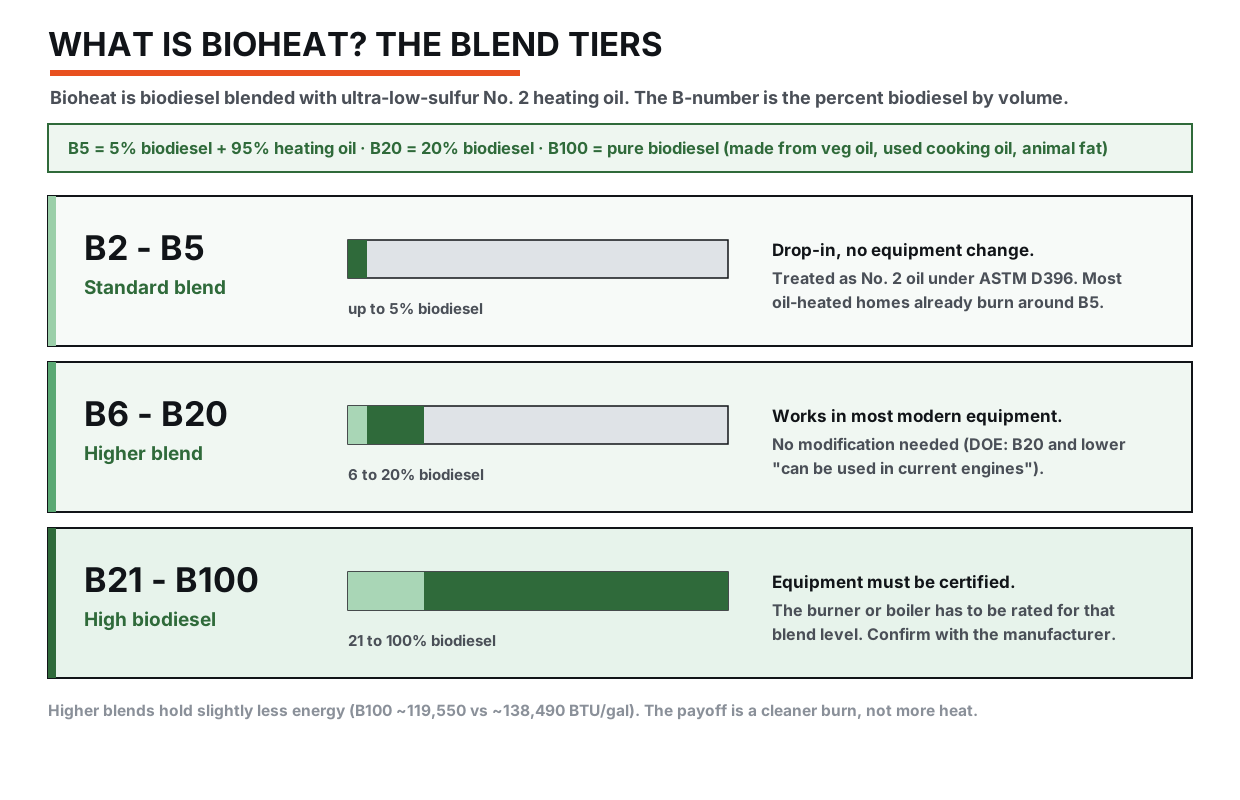
Bioheat fuel is a blend of biodiesel (made from vegetable oils, used cooking oil, or animal fats) with ultra-low-sulfur No. 2 heating oil. The B-number is the percent biodiesel: B5 is 5 percent, B20 is 20 percent, B100 is pure biodiesel. B5 and below are a drop-in for any oil system, B6 to B20 work in most modern equipment without changes, and B21 and up need equipment certified for the blend.
On this page 9 sections
Some links on this page are affiliate links: as an Amazon Associate this site earns from qualifying purchases, and it may earn from other retail partners, at no extra cost to you. Parts shown are general references, not specific endorsements. Match any part to your unit's make, model, and spec before buying.
Bioheat® here means the registered heating-fuel blend (biodiesel plus heating oil). It is not the topical pain-relief supplement, the academic “bioheat equation” for heat transfer in tissue, or any olive-oil brand.
The blend tiers at a glance
| Blend | Biodiesel (by volume) | Equipment impact |
|---|---|---|
| B2 to B5 | 2 to 5% | Drop-in; treated as equal to No. 2 oil under ASTM D396 |
| B6 to B20 | 6 to 20% | Compatible with most existing equipment, no modification in most modern systems |
| B21 to B100 | 21 to 100% | Equipment must be certified for the blend level |
Source: ASTM D396 and D7467; NORA Technicians Manual Ch. 1 (“a blend of B5 is considered the equivalent to normal #2 fuel”).
What Bioheat actually is
Bioheat fuel is biodiesel (B100 meeting ASTM D6751) blended with ultra-low-sulfur No. 2 heating oil (15 ppm sulfur or less). The ultra-low-sulfur base is structural: all Bioheat uses ULS heating oil, not the legacy high-sulfur oil of decades past. “Bio heating oil” and “biofuel heating oil” are informal dealer synonyms for the same product, with no separate regulatory meaning.
The B-number is simply the percent biodiesel by volume. B5 is 5 percent biodiesel and 95 percent heating oil, B20 is 20 percent, and B100 is pure biodiesel.
What biodiesel is made from
Biodiesel is a renewable, biodegradable fuel made from vegetable oils (soybean, canola), recycled cooking oil, and animal fats (tallow). True biodiesel (B100) is processed to meet ASTM D6751 so it behaves like a distillate fuel in a burner, which is different from pouring raw vegetable oil into a tank.
Who runs the name
Bioheat is a registered trademark, jointly administered by Clean Fuels Alliance America (formerly the National Biodiesel Board) and NORA (the National Oilheat Research Alliance). A company must sign a license agreement to use the mark.
The standards that govern it
- ASTM D6751 is the quality spec for B100 biodiesel blend stock.
- ASTM D396 (Fuel Oils) covers No. 1 and No. 2 heating oil and permits up to 5 percent biodiesel (B5) within the existing grades, so a B5 blend is treated as ordinary No. 2 oil.
- ASTM D7467 covers B6 to B20 middle-distillate blends.
ASTM added higher heating-oil blend grades in a 2026 update; the exact grade names are still being confirmed.
How much biodiesel can your system take?
- B5 and below: fully drop-in under ASTM D396, no equipment change. Most oil-heated homes already burn around B5.
- B6 to B20: compatible with most modern oil equipment with no modification. The US Department of Energy states B20 and lower blends “can be used in current engines without modifications.”
- B21 and up: the equipment must be certified for that blend level. Confirm with your burner or boiler manufacturer.
A higher blend holds slightly less energy per gallon (B100 is about 119,550 BTU per gallon on the DOE lower-heating-value basis, versus about 138,490 for No. 2 oil), so a home on B20 burns roughly 1 to 2 percent more gallons for the same heat. Bioheat’s payoff is a cleaner burn, not more heat per gallon.
B20 problems
B20 heating oil and higher biodiesel blends carry three real but manageable problems: cold-weather gelling in outdoor tanks, filter clogging in the first season after switching an old sludgy tank (biodiesel is a mild solvent), and seal or metal compatibility in very old equipment. B2 to B5 are essentially trouble-free. The fixes are a supplier and technician job, not a do-it-yourself field shortcut.
What to know before you go higher than B5
A supplier or technician job
Not a do-it-yourself field shortcut. B2 to B5 are essentially trouble-free; these are the risks that come with going higher.
| Concern | When it is a real risk | What helps (and who does it) |
|---|---|---|
| Cold-weather gelling | Higher blends in an outdoor above-ground tank in a cold climate. |
|
| Filter clogging | First season after switching an old, sludgy tank to a higher blend. |
|
| Old-equipment seals and metals | Pre-1990s rubber seals; copper or brass at high blends. |
|
| Storage stability and microbes | Low-turnover summer storage of B20 and up. |
|
Source: NORA Ch. 1; Farm Energy / eXtension; Filter Manufacturers Council TSB 06-1; Brookhaven National Laboratory; NREL
Cold-weather gelling
Biodiesel crystallizes at a warmer temperature than No. 2 oil. Soy B100 has a cloud point around +34 F, versus roughly -18 to +20 F for No. 2 oil and about -40 F for kerosene. A B20 blend cut on a No. 1 (kerosene) base can reach about -25 F, better than B100 but higher than straight No. 2. B2 to B5 have a minimal cold-flow effect.
NORA notes untreated No. 2 oil has an ASTM maximum pour point of 21 F (below which it turns to a waxy gel), with the cloud point typically 10 to 20 F above that, where wax crystals begin clogging lines and filters. A cold-flow additive has to go in before the fuel reaches its pour point, since it cannot dissolve wax that has already formed. Indoor and buried tanks are buffered and rarely a problem; outdoor above-ground tanks are the real risk. Minnesota’s long-running mandate deliberately drops from B20 in summer to B5 in winter for exactly this reason.
The solvent and filter transition

Biodiesel is a mild solvent. When an older tank is switched to a higher blend, it loosens years of accumulated varnish, gum, and sludge off the tank walls and bottom. That debris goes into suspension and clogs the fuel filter, sometimes within hours, and the effect is most pronounced above B20 in old, deposit-heavy systems. This is documented by the Filter Manufacturers Council (TSB 06-1) and NORA’s own study on biodiesel and pre-existing tank sediment.
The fix is to plan for more frequent filter inspection and replacement for the first season after switching, with a professional tank cleaning beforehand in severe cases. It is a known, manageable transition issue, not a reason to avoid Bioheat.
Older-equipment compatibility
Most oil equipment is rated and warranted only for blends up to B5 unless the manufacturer specifically lists higher, so anything above B5 is something to confirm against your equipment’s documentation and with your installer, not to assume.
Some links on this page are affiliate links: as an Amazon Associate this site earns from qualifying purchases, and it may earn from other retail partners, at no extra cost to you. Parts shown are general references, not specific endorsements. Match any part to your unit's make, model, and spec before buying.
- Seals: very old equipment may use natural rubber or certain nitrile compounds that biodiesel can degrade; the preferred materials are fluoroelastomer (Viton) or Teflon. The good news: Brookhaven National Laboratory durability testing found the high-acrylonitrile nitrile rubber used in common modern oil-burner seals fully compatible with blends up to B100, and ASTM approved B6 to B20 for heating in 2015.
- Riello burners: the hydraulic jack (the fuel-pressure piston that opens the air damper on a Riello) has seals biodiesel is hard on, so a leaking jack is a common bio-related failure on these units. The fixes are technician jobs: eliminate the hydraulic jack with a plug kit (search Amazon), or upgrade to a Riello electronic air shutter (search Amazon).
- Metals: standard steel and fiberglass tanks are fine to B20; copper, brass, and zinc (“yellow metals”) are a concern at higher blends because copper catalyzes biodiesel oxidation. Prefer steel, aluminum, or Teflon-lined components.
- Storage: biodiesel oxidizes and picks up water faster than petroleum oil, so low-turnover summer storage of B20 and up benefits from a reputable supplier and pre-season service. A 2023 study also found higher blends support more microbial growth, driven by that water pickup.
- Flame signal: a higher bio blend can read as higher cad cellcad cellThe light sensor that proves a flame is burning. If it cannot see flame fast enough, the primary control locks the burner out. resistance, because the flame’s brightness shifts. On a system whose cad cell already reads high, that can be enough to tip it into nuisance lockouts, so check the cad cell before stepping up the blend.
Warranty coverage above B20 is not standard, and higher blends may require certified components. What this means for a homeowner is simple: at the annual tune-up, a technician checks seals, the tank anode, water, and sludge. The blend choice and any component change belong to your heating professional, not to a field workaround.
Keep reading
- Bioheat vs heating oil: is it cheaper, cleaner, better?
- Heating oil vs diesel vs kerosene vs Bioheat
Parts behind this fault
Some links on this page are affiliate links: as an Amazon Associate this site earns from qualifying purchases, and it may earn from other retail partners, at no extra cost to you. Parts shown are general references, not specific endorsements. Match any part to your unit's make, model, and spec before buying.
- Oil filter and cartridgeCatches sludge and water before they reach the pump and nozzle. Check price on Amazon
- Oil tank treatmentAn additive that disperses water, controls sludge, and inhibits the microbes that grow at the oil and water line in a tank. Check price on Amazon
- Water-finding pasteA paste smeared on the bottom of the gauge stick before you dip the tank. Check price on Amazon
- Cold-flow (anti-gel) additiveA winter treatment that lowers the temperature at which heating oil or a biodiesel blend gels, so the fuel keeps flowing through the line and the filter in a cold snap. Check price on Amazon
The other 4 parts a technician reaches for on this fault, with what each does and when it gets replaced: all oil burner parts by symptom.
Sources
- NORA Oil Heat Technicians Manual, Ch. 1 (Heating Oil and Its Properties)
- NORA, Bioheat registered trademark agreement, 2022 (noraweb.org)
- US DOE Alternative Fuels Data Center (afdc.energy.gov/fuels/biodiesel-blends)
- ASTM D6751 (B100), D396 (heating oil, permits B5), D7467 (B6 to B20)
- Clean Fuels Alliance America (cleanfuels.org)
- NORA Oil Heat Technicians Manual, Ch. 1 (pour point, cloud point, additive timing)
- Farm Energy / eXtension; Clean Fuels Alliance America (cold flow)
- Filter Manufacturers Council TSB 06-1; NORA Technical Publications (tank sediment)
- Brookhaven National Laboratory durability testing (via Oil & Energy Online); ASTM D7467
- Penn State Extension; NREL water/oxidation study