Bioheat vs heating oil: is it cheaper, cleaner, better?
Updated 18 Oct 2026
Quick answer
Bioheat (biodiesel blended with heating oil) runs about price-parity with No. 2 oil at B5 to B10 and a few cents more per gallon at B20. It burns cleaner (lower sulfur, fewer deposits) but holds slightly fewer BTUs per gallon at higher blends, so a home on B20 burns roughly 1 to 2 percent more for the same heat. There is no direct consumer tax credit, and most modern systems take up to B20 as a drop-in.
On this page 6 sections
Bioheat® here means the registered heating-fuel blend (biodiesel plus heating oil). It is not the topical supplement, the academic “bioheat equation,” or an olive-oil brand.
The short answer, side by side
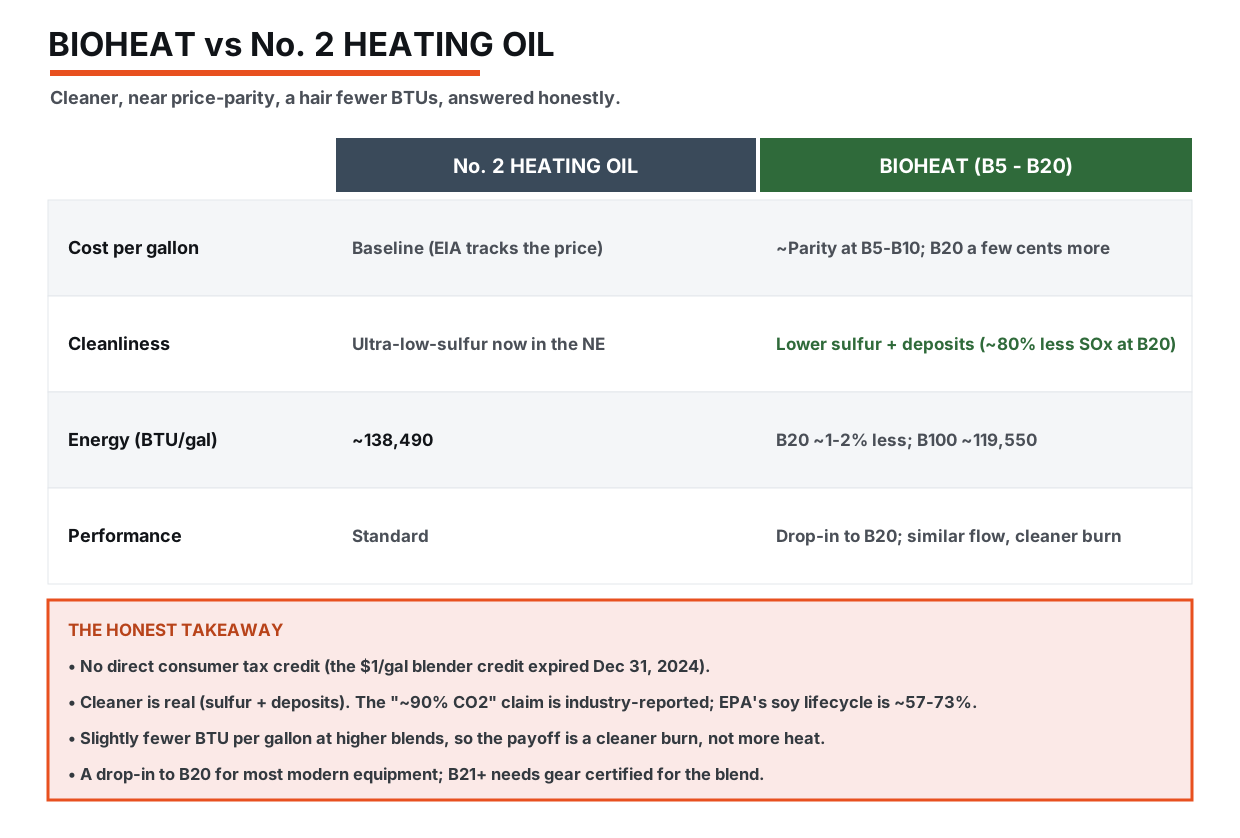
| Question | No. 2 heating oil | Bioheat (B5 to B20) | Honest takeaway |
|---|---|---|---|
| Cost per gallon | Baseline (EIA tracks it) | About parity at B5 to B10; B20 a few cents more | No consumer tax credit; the old $1/gal blender credit expired Dec 31, 2024 |
| Cleanliness | Ultra-low-sulfur now in the Northeast; fewer deposits | Lower sulfur plus fewer deposits; up to about 80% less sulfur oxide at B20 | Cleaner is real; the high “~90% CO2” figures are industry-reported |
| Energy (BTU/gal) | About 138,490 (DOE lower heating value) | B100 about 119,550; B20 about 1 to 2% less than No. 2 | Slightly fewer BTUs per gallon at higher blends |
| Performance | Standard | Similar atomizationatomizeTo break oil into a fine mist so it burns cleanly. The nozzle does this under pump pressure. and flow; cleaner burn | A drop-in to B20 for most modern equipment |
Source: EIA No. 2 price series; DOE AFDC fuel-comparison and biodiesel-blends pages; NORA Technicians Manual Ch. 1.
Is Bioheat cheaper than oil?
At the pump it is roughly price-parity at B5 to B10, with B20 typically a few cents per gallon above straight heating oil. The spread tracks the biodiesel-versus-diesel differential, and the EIA tracks No. 2 heating oil but does not publish a separate Bioheat retail series.
There is no direct consumer tax credit for buying Bioheat. The federal benefit was a blender-level credit ($1.00 per gallon of biodiesel blended, IRC 6426) that expired December 31, 2024 and was replaced January 1, 2025 by the 45Z Clean Fuel Production Credit, which flows to producers by carbon intensity. Some dealer pages advertise a “20 cents per gallon tax benefit,” which is a simplification of the old blender credit, not a consumer credit.
Is Bioheat cleaner?
Yes. All Bioheat uses ultra-low-sulfur oil (15 ppm or less) versus legacy oil up to 500 ppm, which sharply cuts sulfur-oxide emissions (NORA notes a B20 blend can cut sulfur oxide up to about 80 percent versus pre-ULS oil) and leaves fewer heat-exchanger deposits (NORA: ultra-low-sulfur oil “all but eliminates scale and soot”).
Industry lifecycle figures claim up to about 90 percent CO2 reduction at B100. Treat that as an industry-reported number: independent EPA lifecycle analysis of soy biodiesel typically shows roughly a 57 to 73 percent reduction, and feedstock matters. The sulfur and deposit benefits are solid; the high lifecycle-CO2 percentages are claims.
Does it heat the same?
Almost. A higher blend holds marginally less energy per gallon. On the DOE lower-heating-value basis, B100 is about 119,550 BTU per gallon versus about 138,490 for No. 2 oil (NORA cites about 128,000 for B100 on a different, higher basis). In practice a home on B20 burns roughly 1 to 2 percent more gallons for the same heat, and at B5 the difference is under half a percent. The payoff is a cleaner burn that can keep a system at peak efficiency longer, not more heat per gallon.
The mandate tailwind (why this is coming up now)
Northeast states are phasing in biodiesel blend requirements, which is what is driving the demand for answers. Kerosene is typically exempt.
| State | Blend schedule |
|---|---|
| New York | B5 (2022), B10 (2025), B20 (2030) |
| Connecticut | B5 (2022), B10 (2025), B15 (2030), B20 (2034), B50 (2035) |
| Rhode Island | B10 (2023), B20 (2025), B50 (2030) |
| Massachusetts | No active statewide mandate (suspended 2010); confirm current status |
Source: NY S3321A; CT Public Act 21-26; RI H5132A; MA DOER.
Keep reading
- What is Bioheat fuel? B5, B10, B20, and B100 explained
- B20 and higher-blend problems: gelling, filters, old equipment
- Heating oil vs diesel vs kerosene vs Bioheat
Sources
- NORA Oil Heat Technicians Manual, Ch. 1 (Heating Oil and Its Properties)
- US DOE Alternative Fuels Data Center (afdc.energy.gov/fuels/biodiesel-blends)
- US EIA No. 2 heating oil price series (eia.gov)
- Clean Fuels Alliance America (cleanfuels.org); EPA RFS lifecycle analysis
- NY S3321A; CT Public Act 21-26; RI H5132A; MA DOER