How to read an oil tank gauge (and why a stick beats it)
Updated 18 Oct 2026
Quick answer
The float gauge reads like a fuel gauge: the marker in the clear dome shows F, 3/4, 1/2, 1/4, and E as a fraction of the tank. On a 275-gallon tank, 1/2 is about 134 gallons. Gauges stick, though, so when the level matters, confirm it by sticking the tank and converting inches to gallons with a chart.
On this page 6 sections
What the gauge is actually showing
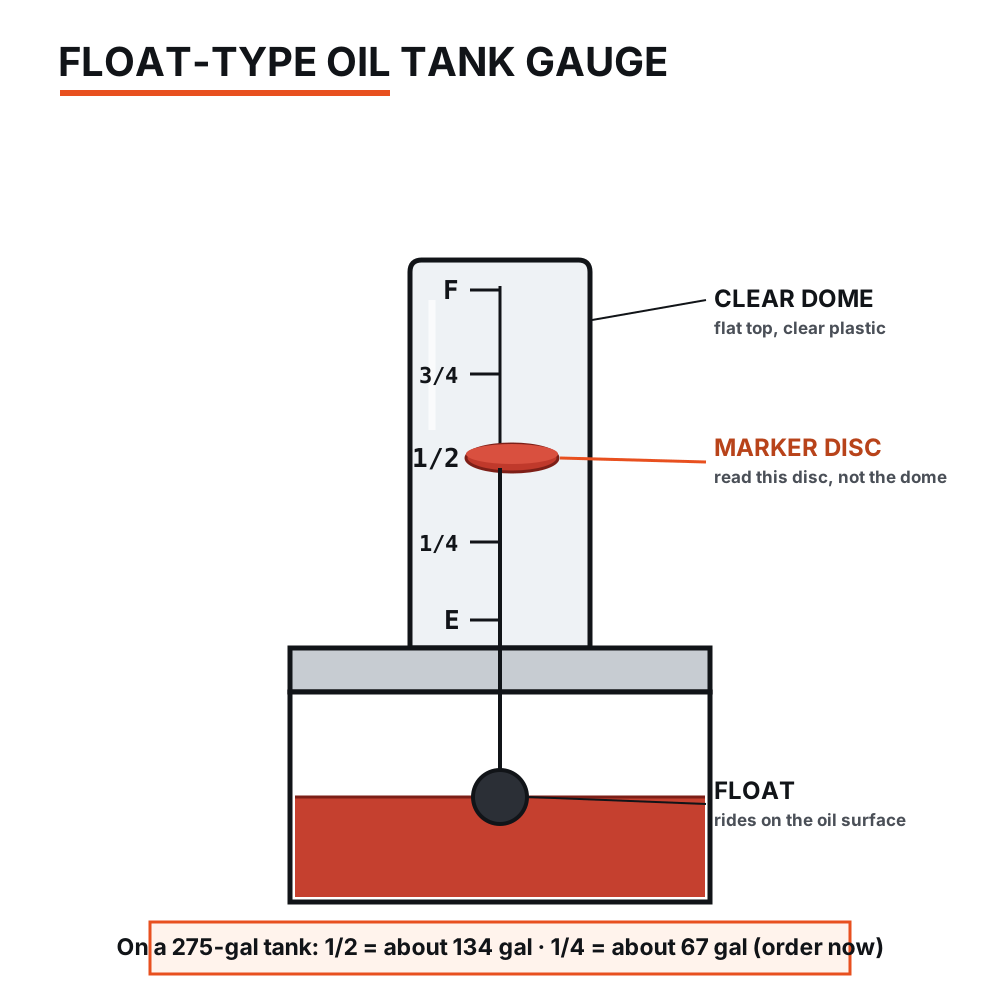
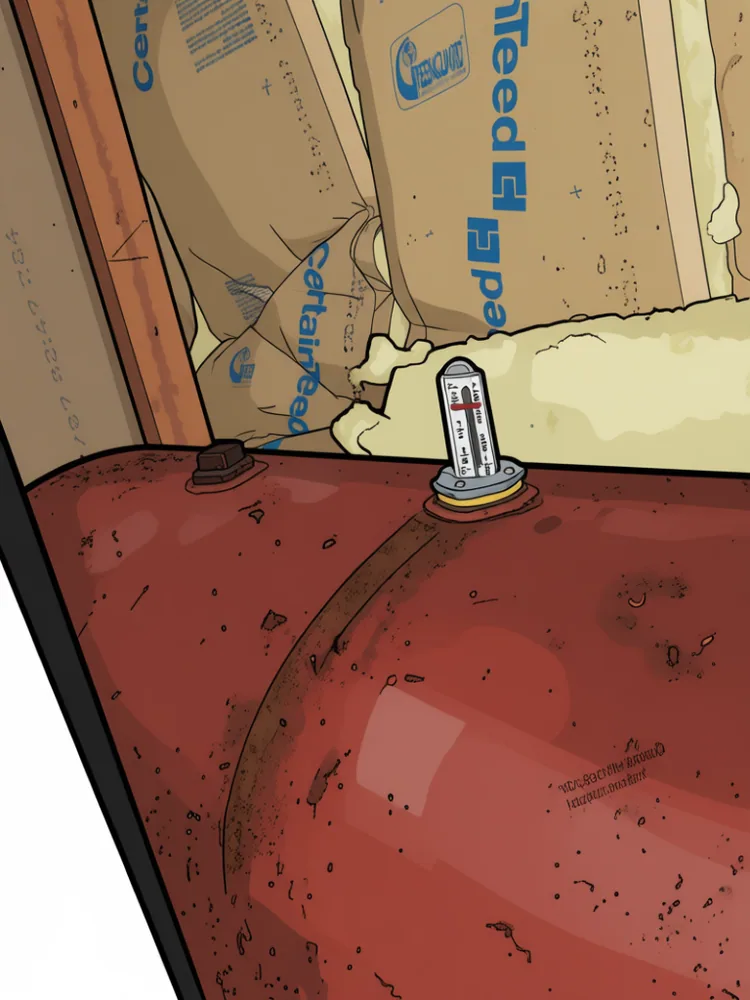
The gauge on top of your tank is a float gauge: a float rides on the surface of the oil, an arm lifts a marker inside the clear plastic dome, and the marker lines up with F, 3/4, 1/2, 1/4, and E. It works exactly like the gas gauge in a car, and it reads the same way: as a fraction of the tank, not a number of gallons.
To turn the fraction into gallons, multiply by what the tank actually holds. A standard 275-gallon tank holds about 268 gallons when full (“275” is a nominal size), and the gauge reads as a fraction of that, so:
- Full is about 268 gallons (the marker rarely pegs at the very top).
- 3/4 is roughly 200.
- 1/2 is roughly 134.
- 1/4 is roughly 67, and that is your “order now” line in winter.
Usable capacity is a little less, since fills stop short of the top and the last inches sit below the outlet, so a fill-up on a near-empty 275 typically takes a bit over 200 gallons.
Reading it correctly
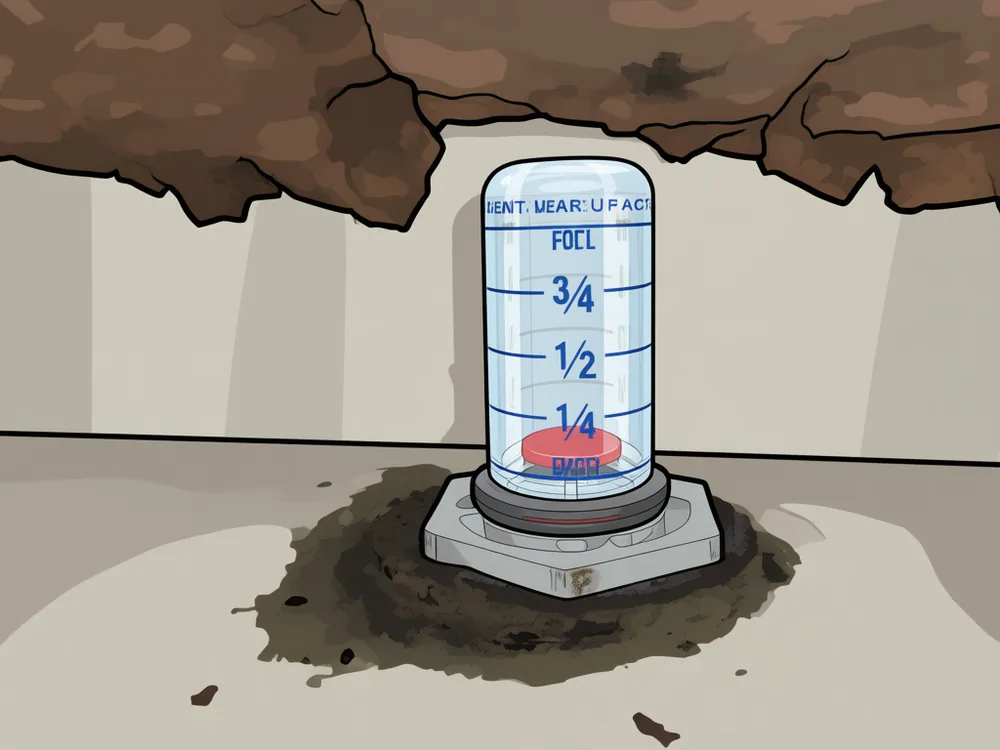
- Look at the marker disc inside the dome, not the top of the dome. It is usually a red or black disc the float arm pushes up.
- A disc sitting flat on the bottom of the dome means the gauge reads empty (or the float sank, see below).
- Tap the dome gently. A marker that jumps when you tap it was stuck, which is the whole problem with trusting gauges.
Why gauges lie
Float gauges are the single most over-trusted part of an oil system. They fail in two ways, and both are dangerous because they read higher than reality:
- The float sticks on its arm or against the tank wall, freezing the marker at a reading while the oil keeps dropping. A gauge stuck at 1/4 over a dry tank is a classic run-out.
- The float sinks (it can fill with oil over the years), so the gauge reads near empty no matter the level.
If the marker never moves between deliveries, or never seems to drop, treat the gauge as suspect and replace it (it is a cheap part).
The 30-second stick check (the truth)
When the level actually matters, a wooden stick does not lie:
- Use a clean, dry wooden dowel or yardstick long enough to reach the bottom (about 44 inches for a vertical 275).
- Open the fill or gauge fitting and lower the stick straight down until it rests on the bottom.
- Pull it out and read the wet line in inches.
- Convert inches to gallons with the tank chart.
That is the same method delivery drivers use, and it is the only way to know for sure before a cold stretch. While you are at it, a band of water-finding paste on the stick will also tell you whether water has collected in the bottom.
A rule of thumb for winter
Do not let the tank fall below a quarter in heating season. A low tank both runs out sooner and pulls the most sludge toward the pickup, and a stuck gauge turns “I thought I had a quarter tank” into a 6 a.m. no-heat call. If remembering is the hard part, ask your dealer about automatic delivery, which uses degree-daydegree-dayA measure of how cold a day was: how many degrees the average temperature fell below 65 F. More degree-days means more oil burned. math (the same idea as the oil usage estimator) to top you off before you get low.
Parts behind this fault
Some links on this page are affiliate links: as an Amazon Associate this site earns from qualifying purchases, and it may earn from other retail partners, at no extra cost to you. Parts shown are general references, not specific endorsements. Match any part to your unit's make, model, and spec before buying.
- Oil tank float gaugeThe dial on top of the tank that shows the oil level on a float. Check price on Amazon
- Tank vent whistleThe vent fitting that whistles while the tank fills and goes silent when it is full, so a delivery does not overfill. Check price on Amazon
- Tank fill and vent capsCaps that seal the fill and vent pipes so water and debris stay out of the tank. Check price on Amazon
What each one does and when it gets replaced: all oil burner parts by symptom.
Sources
- Manufacturer documentation for float-type oil tank gauges (Scully, Krueger)
- Residential oil tank capacity references