⚠Educational only. Oil heat involves fire, electrical, and carbon-monoxide hazards. Know what is safe to check, and when to stop and call a licensed technician.
Oil burner parts by diagram and by symptom
Oil burner parts, found two ways: pick your burner below for a labeled exploded diagram with
OEM part numbers and where to buy, or start from the symptom further down. Not sure which part
does what? Start with how an oil furnace works. Installing
burner parts and setting combustion is licensed-technician work; this page is for understanding
the fix and sourcing the right part.
Some links on this page are affiliate links: as an Amazon Associate this site earns from qualifying purchases, and it may earn from other retail partners, at no extra cost to you.
Parts shown are general references, not specific endorsements. Match any part to your unit's
make, model, and spec before buying.
Oil burner parts diagrams by burner
Know your burner? Jump straight to its labeled diagram and part numbers.
A sheet of oil-only sorbent laid under the burner, filter, and pump. It catches the drips from a filter change, a bleed, or a weeping fitting before they soak into the floor and leave the boiler room smelling of oil.
Replace it when: Whenever a pad is saturated or you can smell oil near the burner. Put a fresh one down before a filter change or a bleed, and keep a pack on the shelf.
It fires, then the control will not prove the flame
The burner lights but the cad cell cannot confirm it, so the primary control shuts down. Usually a sooted or mispositioned cad cell, or a flame-quality problem behind it.
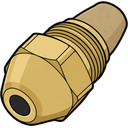
Atomizes the oil into a fine spray for combustion. It is sized by flow rate (GPH), spray angle, and pattern, so the replacement has to match the burner's spec exactly.
Replace it when: Every tune-up, and any time the flame is sooty or smoky or the burner will not light cleanly.
Sounds when carbon monoxide builds up. Every oil-heated home should have one on each level and one near the boiler room, because a sooted chamber, a blocked flue, or a puffback can put CO into the house before anyone smells oil.
Replace it when: When it chirps end-of-life (sensors last 7 to 10 years), if it is older than the date printed on the back, or if the house has none.
A run-out pulls air and tank sludge into the line. Bleeding, a fresh filter, and sometimes a de-aerator are what get it running again. Wondering about a stopgap fuel? Read can you put diesel or kerosene in an oil tank.
A sheet of oil-only sorbent laid under the burner, filter, and pump. It catches the drips from a filter change, a bleed, or a weeping fitting before they soak into the floor and leave the boiler room smelling of oil.
Replace it when: Whenever a pad is saturated or you can smell oil near the burner. Put a fresh one down before a filter change or a bleed, and keep a pack on the shelf.
The flexible flare-ended lines that connect the burner (or a de-aerator) to the rigid oil line, so the burner can be swung open for service without unmaking fittings.
Replace it when: Cracked, stiff, kinked or weeping, and whenever the burner is repiped for a de-aerator.
Any strong oil smell, smoke, or soot is a stop-and-call situation first, because of the carbon-monoxide and puffback risk. These are the parts a technician most often corrects once it is safe.
Atomizes the oil into a fine spray for combustion. It is sized by flow rate (GPH), spray angle, and pattern, so the replacement has to match the burner's spec exactly.
Replace it when: Every tune-up, and any time the flame is sooty or smoky or the burner will not light cleanly.
Sounds when carbon monoxide builds up. Every oil-heated home should have one on each level and one near the boiler room, because a sooted chamber, a blocked flue, or a puffback can put CO into the house before anyone smells oil.
Replace it when: When it chirps end-of-life (sensors last 7 to 10 years), if it is older than the date printed on the back, or if the house has none.
Water, sludge, and cold-weather gelling start in the tank. These are the consumables that keep the fuel clean before it reaches the filter and the nozzle.
A paste smeared on the bottom of the gauge stick before you dip the tank. It changes color exactly where it touched water, so you read the water depth separately from the oil above it.
Replace it when: Use it whenever water is the suspect: a filter that keeps loading up, sludge, or a burner that starves after a delivery. A trace is common and managed with treatment; more than a trace, or water that keeps coming back, means the tank needs pumping and cleaning.
A winter treatment that lowers the temperature at which heating oil or a biodiesel blend gels, so the fuel keeps flowing through the line and the filter in a cold snap.
Replace it when: Before cold weather, while the fuel is still clear: an additive cannot dissolve wax that has already formed, so it has to be in the tank before the fuel reaches its cloud point. Outdoor above-ground tanks are the ones at risk; indoor and buried tanks are buffered and rarely need it.
A sheet of oil-only sorbent laid under the burner, filter, and pump. It catches the drips from a filter change, a bleed, or a weeping fitting before they soak into the floor and leave the boiler room smelling of oil.
Replace it when: Whenever a pad is saturated or you can smell oil near the burner. Put a fresh one down before a filter change or a bleed, and keep a pack on the shelf.
Atomizes the oil into a fine spray for combustion. It is sized by flow rate (GPH), spray angle, and pattern, so the replacement has to match the burner's spec exactly.
Replace it when: Every tune-up, and any time the flame is sooty or smoky or the burner will not light cleanly.
The flexible flare-ended lines that connect the burner (or a de-aerator) to the rigid oil line, so the burner can be swung open for service without unmaking fittings.
Replace it when: Cracked, stiff, kinked or weeping, and whenever the burner is repiped for a de-aerator.
Parts and brands listed are the common, widely available ones for residential oil heat.
Price figures are rough estimates, not live prices, and the exact part has to match your
unit's make, model, and spec. Shopping links are affiliate links. The "Often replaced at the
same visit" lines come from aggregate service records (counts of what was replaced on the same
visit, nothing more) and are a prompt to check the neighboring part, not a rule.