How to bleed and prime an oil furnace after running out
Updated 18 Oct 2026
Quick answer
Bleeding and priming an oil furnace after running out clears the air trapped in the fuel line, which keeps the burner from firing even with a full tank. Clearing it means cracking the bleed port on the pump while the burner runs and purging until the oil streams out clear and air-free. It is a real DIY job for a careful owner, but it involves pressurized fuel and a live burner, so know the hazards or let the delivery driver do it, it is often free with the fill.
On this page 8 sections
Why the burner won’t fire even though the tank is full again
Run the tank dry and the pump spends its last minute pulling air instead of oil. That air does not just leave when oil comes back: it sits in the suction linesuction lineThe oil line the pump draws fuel through from the tank. An air leak here causes hard starts and lockouts. as a compressible bubble the pump cannot push through, so the burner cranks, fails to get a solid shot of fuel, and locks out. This is an airlock, and it is the normal result of a run-out, not a sign anything broke.
A second thing happened down in the tank: the last inch of oil sat on top of years of settled sludge, and running dry stirred that sludge toward the pickup and the filter. So clearing the air is usually paired with a fresh filter.
First, which system do you have
Look at the piping at the pump, do not disconnect anything:
- Single pipesingle pipeAn oil supply setup with one line from the tank to the burner pump. Simple, but it can trap air after a run-out, which is why a de-aerator helps.. One line runs from the tank to the pump. It cannot purge its own air, so after a run-out it has to be bled by hand. Most basement tanks sitting near or above the burner are single pipe.
- Two pipetwo pipeAn oil supply setup with a supply line and a return line back to the tank, so the pump self-purges air. Common where the tank sits below the burner.. A supply line and a return line run to the tank, and the return carries air back automatically, so a two-pipe system often re-primes on its own after a run-out. Tanks below the burner usually need this.
- Single pipe with a Tigerloop de-aerator. The de-aeratorde-aeratorA small device that removes air from the oil line so a single-pipe system self-bleeds instead of locking out. Tigerloop is the common brand. self-bleeds, so these usually restart without your help. A house that airlocks every time it runs low is the classic candidate for adding one.
How the bleed and prime are done
A technician usually does this through the control’s own pump primeprimeGetting oil flowing through the pump and out the nozzle on a dry or air-bound line, done at the pump's bleed port. mode, which keeps the motor running while the air comes out; the entry sequence and time limit for each primary are on the pump prime mode page.
The procedure is in every burner manual and all over the trade videos, so here is the honest version, with the warning up front. Read this before you start: the bleedbleedPurging air from the oil line at the pump's bleed port so the burner can draw fuel again, usually after a run-out. puts fuel oil under pump pressure and a firing burner in play together. Eye protection, rags, and a container are not optional, and if that combination is not for you, the next section is the easy out.
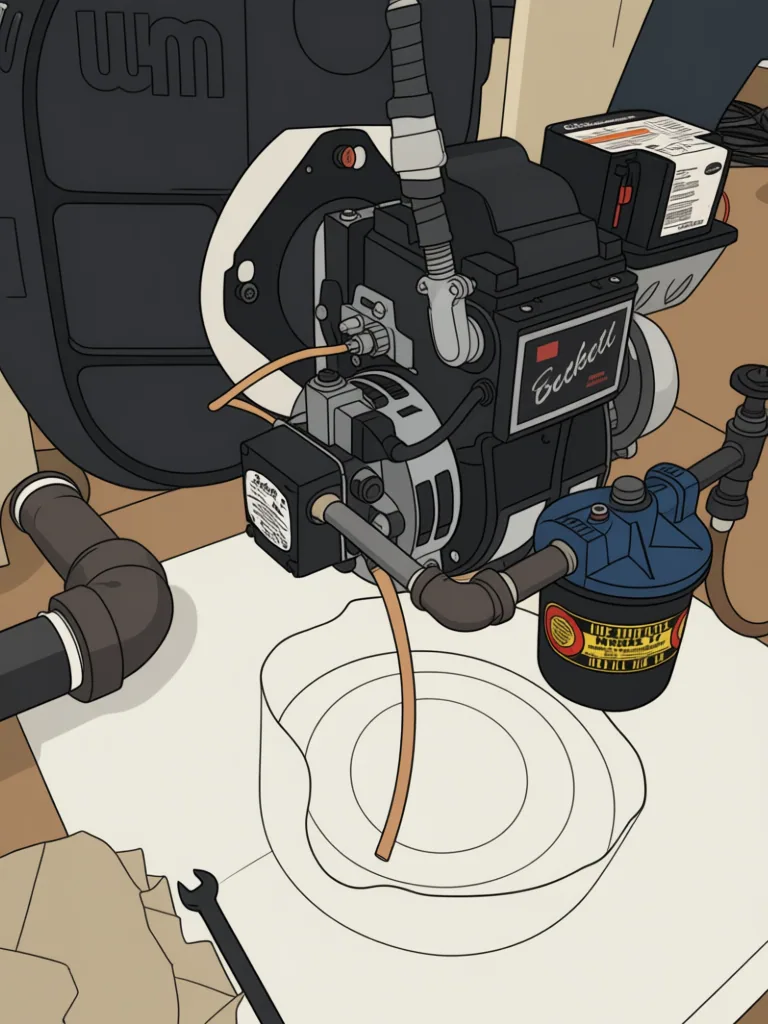
- Find the bleed port. It is a hex nipple or small valve on the body of the fuel pump, the strainerstrainerA mesh filter inside the fuel pump that catches debris. It is cleaned or replaced as part of a tune-up.-and-gear unit the burner motor drives. Suntec and Webster are the common makes, and the screw usually takes a 3/8 inch or 7/16 inch wrench.
- Rig a hose. Slip a clear plastic hose over the bleed nipple and run the other end into a glass jar or a clear container, so you can see oil going from foamy to clear.
- Run the burner and crack the screw. With the thermostat calling, start the burner and open the bleed screw about half a turn while the pump is running. Oil, foam, and trapped air spit out into the jar.
- Purge until it streams clean. Keep it open until the flow is steady and bubble-free, usually several seconds to about half a minute, then close the screw snug before the control’s trial window times out. On a stubborn prime you may need to let the control resetresetThe button that clears a lockout for one more ignition attempt. Press it once only, never repeatedly. and repeat, but mind the one-reset discipline below.
- Change the filter and check for leaks. Swap the filter cartridge (a run-out drags sludge into it), then watch every fitting you touched for weeping once the burner runs clean.
The hazards, said plainly
- Pressurized fuel. Oil leaves the bleed port under pump pressure. It sprays, it is flammable, and it gets on everything. Eye protection and rags staged in advance.
- A live burner. You are bleeding while the burner tries to fire, so you are racing its 15 to 45 second trial window. If it locks out, the one reset only rule still holds: never stack resets to force a start, that is how unburned oil pools and sets up a puffback.
- Codes and your manual win. NFPA 31NFPA 31The national standard for installing oil-burning equipment. Most oil-heat install and safety rules trace back to it. and your burner manufacturer’s own instructions govern this work. If your owner manual documents a bleed procedure for your exact unit, follow that document, not a website. Proceed at your own risk, or hire it out.
- The hard line. Bleeding only removes air. It never bypasses the cad cellcad cellThe light sensor that proves a flame is burning. If it cannot see flame fast enough, the primary control locks the burner out., the primary controlprimary controlThe small box on the burner that runs the ignition sequence, watches the cad cell, and latches into lockout on a failed start., or any limit, and this guide will never tell you to. If a restart seems to need a safety jumped or fooled, stop and call.
The easy out: let the delivery do it
Many dealers prime and bleed the line for free as part of an emergency or next-day delivery, because they would rather do it right than get a callback. When you order after a run-out, say it ran dry and ask whether the prime is included. If the diesel stopgap is holding the house, a scheduled delivery with a free prime often beats both an after-hours charge and doing it yourself.
What the technician checks beyond the bleed
- The filter and pump strainer (run-outs load them with sludge).
- The nozzlenozzleThe precision tip that atomizes oil into a fine spray for burning. It is sized by flow rate, spray angle, and pattern., if repeated lockouts sprayed and fouled it.
- Pump pressure and vacuumvacuumThe suction the pump pulls on the line. A technician measures it to find a clogging filter or an air leak. with gauges, to confirm the prime held and the line is tight, followed by a combustion check if anything was off.
Avoiding the next airlock
- Stick the tank weekly in winter with the tank chart, and do not trust the float gauge.
- Set up automatic delivery so a will-call is never forgotten; the oil usage estimator shows the degree-daydegree-dayA measure of how cold a day was: how many degrees the average temperature fell below 65 F. More degree-days means more oil burned. math dealers use.
- Consider a de-aerator if your single-pipe system airlocks every time it runs low.
Parts behind this fault
Some links on this page are affiliate links: as an Amazon Associate this site earns from qualifying purchases, and it may earn from other retail partners, at no extra cost to you. Parts shown are general references, not specific endorsements. Match any part to your unit's make, model, and spec before buying.
- Oil absorbent padsA sheet of oil-only sorbent laid under the burner, filter, and pump. Check price on Amazon
- Oil filter and cartridgeCatches sludge and water before they reach the pump and nozzle. Check price on Amazon
- Fuel oil de-aeratorPurges air from the oil line so a one-pipe system self-bleeds after a run-out instead of locking out on air. Check price on Amazon
- Flexible oil linesThe flexible flare-ended lines that connect the burner (or a de-aerator) to the rigid oil line, so the burner can be swung open for service without unmaking fittings. Check price on Amazon
The other 5 parts a technician reaches for on this fault, with what each does and when it gets replaced: all oil burner parts by symptom.
Sources
- Suntec and Webster fuel unit (oil pump) bleed and prime instructions
- R.W. Beckett burner owner-information sheets
- NFPA 31: Standard for the Installation of Oil-Burning Equipment