⚠Educational only. Oil heat involves fire, electrical, and carbon-monoxide hazards. Know what is safe to check, and when to stop and call a licensed technician.
Oil burner nozzle chart & firing rate
Updated 26 Sep 2026
Quick answer
This oil burner nozzle chart lists nozzles by GPH, spray angle and pattern; enter a nozzle's rated GPH and your pump pressure to get the actual firing rate and heat input. Any nozzle change has to match what the burner manufacturer specifies.
Firing rate calculator
Actual firing rate = rated GPH × the square root of (pressure ÷ 100). Heat input uses
138,500 BTU per gallon for No. 2 oil. Raising pump pressure raises the firing rate, but only
change it to a value the burner manufacturer allows.
Firing rate by pump pressure (actual GPH)v0.1Last verified 2026-09-25
Rated GPH
BTU/hr at 100 psi
100 psi
110 psi
120 psi
130 psi
140 psi
150 psi
160 psi
170 psi
180 psi
190 psi
200 psi
210 psi
220 psi
230 psi
240 psi
250 psi
260 psi
270 psi
280 psi
290 psi
300 psi
0.40
55,400
0.40
0.42
0.44
0.46
0.47
0.49
0.51
0.52
0.54
0.55
0.57
0.58
0.59
0.61
0.62
0.63
0.64
0.66
0.67
0.68
0.69
0.50
69,250
0.50
0.52
0.55
0.57
0.59
0.61
0.63
0.65
0.67
0.69
0.71
0.72
0.74
0.76
0.77
0.79
0.81
0.82
0.84
0.85
0.87
0.60
83,100
0.60
0.63
0.66
0.68
0.71
0.73
0.76
0.78
0.80
0.83
0.85
0.87
0.89
0.91
0.93
0.95
0.97
0.99
1.00
1.02
1.04
0.65
90,025
0.65
0.68
0.71
0.74
0.77
0.80
0.82
0.85
0.87
0.90
0.92
0.94
0.96
0.99
1.01
1.03
1.05
1.07
1.09
1.11
1.13
0.75
103,875
0.75
0.79
0.82
0.86
0.89
0.92
0.95
0.98
1.01
1.03
1.06
1.09
1.11
1.14
1.16
1.19
1.21
1.23
1.25
1.28
1.30
0.85
117,725
0.85
0.89
0.93
0.97
1.01
1.04
1.08
1.11
1.14
1.17
1.20
1.23
1.26
1.29
1.32
1.34
1.37
1.40
1.42
1.45
1.47
1.00
138,500
1.00
1.05
1.10
1.14
1.18
1.22
1.26
1.30
1.34
1.38
1.41
1.45
1.48
1.52
1.55
1.58
1.61
1.64
1.67
1.70
1.73
1.10
152,350
1.10
1.15
1.20
1.25
1.30
1.35
1.39
1.43
1.48
1.52
1.56
1.59
1.63
1.67
1.70
1.74
1.77
1.81
1.84
1.87
1.91
1.25
173,125
1.25
1.31
1.37
1.43
1.48
1.53
1.58
1.63
1.68
1.72
1.77
1.81
1.85
1.90
1.94
1.98
2.02
2.05
2.09
2.13
2.17
1.35
186,975
1.35
1.42
1.48
1.54
1.60
1.65
1.71
1.76
1.81
1.86
1.91
1.96
2.00
2.05
2.09
2.13
2.18
2.22
2.26
2.30
2.34
1.50
207,750
1.50
1.57
1.64
1.71
1.77
1.84
1.90
1.96
2.01
2.07
2.12
2.17
2.22
2.27
2.32
2.37
2.42
2.46
2.51
2.55
2.60
1.65
228,525
1.65
1.73
1.81
1.88
1.95
2.02
2.09
2.15
2.21
2.27
2.33
2.39
2.45
2.50
2.56
2.61
2.66
2.71
2.76
2.81
2.86
1.75
242,375
1.75
1.84
1.92
2.00
2.07
2.14
2.21
2.28
2.35
2.41
2.47
2.54
2.60
2.65
2.71
2.77
2.82
2.88
2.93
2.98
3.03
2.00
277,000
2.00
2.10
2.19
2.28
2.37
2.45
2.53
2.61
2.68
2.76
2.83
2.90
2.97
3.03
3.10
3.16
3.22
3.29
3.35
3.41
3.46
2.25
311,625
2.25
2.36
2.46
2.57
2.66
2.76
2.85
2.93
3.02
3.10
3.18
3.26
3.34
3.41
3.49
3.56
3.63
3.70
3.76
3.83
3.90
2.50
346,250
2.50
2.62
2.74
2.85
2.96
3.06
3.16
3.26
3.35
3.45
3.54
3.62
3.71
3.79
3.87
3.95
4.03
4.11
4.18
4.26
4.33
2.75
380,875
2.75
2.88
3.01
3.14
3.25
3.37
3.48
3.59
3.69
3.79
3.89
3.99
4.08
4.17
4.26
4.35
4.43
4.52
4.60
4.68
4.76
3.00
415,500
3.00
3.15
3.29
3.42
3.55
3.67
3.79
3.91
4.02
4.14
4.24
4.35
4.45
4.55
4.65
4.74
4.84
4.93
5.02
5.11
5.20
Source: Computed: actual GPH = rated GPH x sqrt(pressure / 100), the standard orifice-flow relationship (R.W. Beckett / NORA nozzle guidance). Asserted at build time against reference points (1.00 GPH at 140 psi is about 1.18 GPH).
The three numbers on a nozzle
An oil burner nozzle is specified by three things: how much it flows (GPH), the angle of its
spray cone, and its spray pattern.
Flow rate (GPH): gallons per hour of No. 2 oil, rated at 100 psi pump pressure. This sets the burner's firing rate.
Spray angle: the cone angle, from about 30 to 90 degrees. Narrow angles suit long fireboxes, wide angles suit short ones; 80 degrees is the most common.
Spray pattern: hollow (A), solid (B), or semi-solid (W). The burner spec calls for a specific one.
30°, 45°, 60°, 70°, 80°, 90°. Match the angle to the firebox shape per the burner spec; 80° is the most common default.
Spray patterns
A (Hollow cone): Concentrates oil toward the outer edge of the cone. Common at lower firing rates and in burners specified for a hollow pattern.
B (Solid cone): Distributes oil throughout the cone. Common at higher firing rates and longer fireboxes.
W (Semi-solid (universal)): Between hollow and solid; often sold as a universal replacement, but use it only where the burner spec allows.
Pattern letters vary by maker (these are the common Delavan designations; Hago and Danfoss
use their own). When in doubt, replace with the exact part the burner tag or your last
nozzle specifies.
Sourcing the nozzle
Some links on this page are affiliate links: as an Amazon Associate this site earns from qualifying purchases, and it may earn from other retail partners, at no extra cost to you.
Parts shown are general references, not specific endorsements. Match any part to your unit's
make, model, and spec before buying.
Read the stamping on the old nozzle. One marked 1.00 80 A flows 1.00 GPH,
sprays an 80 degree cone, and is an A (hollow) pattern: those are the three things to match.
If the stamping is worn off, the burner's rating plate or the appliance manual lists the
nozzle spec.
The size is the appliance's spec, never a number to grow. The wrong nozzle or pressure
makes a sooty, wasteful, or unsafe fire, so match what the manufacturer calls for, and
leave the change and the combustion test to a technician.
Search by size
Uses the rated GPH from the calculator above (enter a rated GPH first).
Check the pattern letter on the listing before you buy: the results match the flow and
angle well, and the letter is the weakest match.
Oil burner nozzle
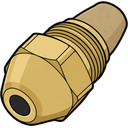
Atomizes the oil into a fine spray for combustion. It is sized by flow rate (GPH), spray angle, and pattern, so the replacement has to match the burner's spec exactly.
Replace it when: Every tune-up, and any time the flame is sooty or smoky or the burner will not light cleanly.