⚠Educational only. Oil heat involves fire, electrical, and carbon-monoxide hazards. Know what is safe to check, and when to stop and call a licensed technician.
Riello (Legnago, Italy) makes the 40-series pressure-jet burners found on Buderus and Weil-McLain retrofits in the US and widespread in the UK and Ireland; this page decodes the 530SE/C control and its flame sensor, lists the sourced setup specs, and shows what a technician checks.
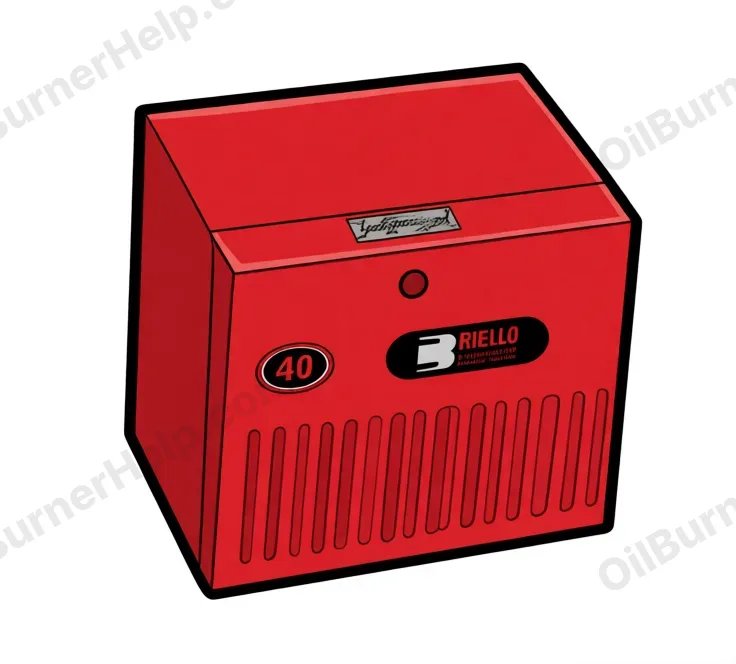
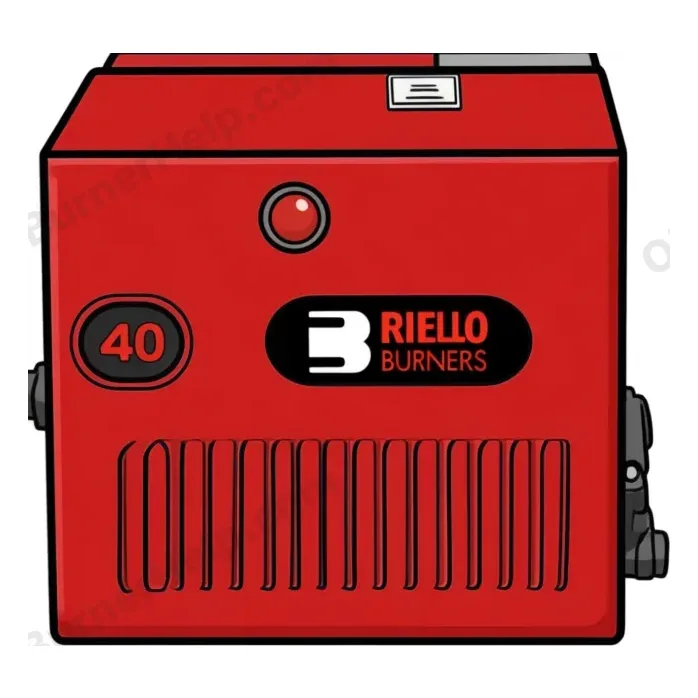
A Riello 40 F. One red cover over everything, with the small reset button on the front.
Riello 40: the control sits under the cover, so what you see is the cover with the red reset button and its lock-out light.
One reset button with a lock-out lamp behind it. The lamp comes on when the control locks out. There is no other light and no flash pattern. The control box holds the safety circuit and the ignition transformer in one module that plugs onto the burner sub-base. Flame is proven by a light sensor in the burner body: a cad cell on burners built before 2019 (part 3002280) and a photodiode from 2019 on (part 20132573). The 525SE/C 24VTT is the same control with thermostat terminals added. It turns up most often on a warm air furnace, and with its jumper left in place it replaces a 530SE/C.
Indication
What it means
Lock-out lamp ON
Safety lock-out. The sensor did not prove flame within about 5 seconds after the 12 second pre-purge. A short or open circuit in the electrodes also locks it out, after about 30 seconds with no oil spray. Press the reset button once. If it locks out again, stop and call.
Burner starts, lamp off, then drops out and retries
Flame was lost during the run. The valve closes at once, the motor runs about 10 more seconds, then the control tries to light again. Repeated recycles end in lock-out. Find the cause.
Burner stays in pre-purge and never lights
The sensor is seeing light during pre-purge, the sub-base is mis-wired, or the valve coil has an open winding. The control will not go to ignition until the sensor reads dark.
Reset once, no restart, sensor suspect
Check the sensor. A cad cell (before 2019) reads under 40,000 ohms in light and over 150,000 ohms in the dark. A glazed or unplugged cell reads wrong and blocks flame proving. A photodiode (2019 on) reads open on an ohm meter and cannot be tested that way.
Source: Riello 40 Series Service Guide 2024 (sequence of operation 4.3-4.5 and troubleshooting chart) and Riello mectron 3M owner manual.
Troubleshooting starts with the symptom. These are the failure patterns the service
literature documents for this burner family, with the checks a technician runs in order.
Nothing happens at all: no motor, no hum
Start with power, not the burner. Check the service switch, the system fuse and the thermostat first. A motor that will not run may have shut down on thermal overload. Let it cool and reset once. If it still will not run, the motor needs replacing. Stop and call.
What the technician checks: Confirms 102 to 132 VAC at the sub-base, closed limits, and a real call for heat. A motor that hums but will not spin usually needs its motor capacitor replaced. A seized pump or motor is replaced, not nursed.
Runs the pre-purge, never lights, lockout lamp comes on
A failed trial for ignition. The photocell must prove flame within about 5 seconds after the roughly 12 second pre-purge, or the control locks out. The everyday causes are an empty tank, a closed valve, a dirty filter, a weak photocell, or electrodes that are dirty or out of position.
What the technician checks: Works the oil supply first: tank level, valves, filter, lines. Then the sensor (a cad cell reads under 40,000 ohms in light and over 150,000 in the dark), the electrodes, pump vacuum (0 to 11 inches Hg) and firing pressure (120 to 200 psi), draft, then the nozzle and pump strainer. Low pressure during pre-purge is normal on these pumps. Firing pressure only shows once the valve opens.
The sensor is seeing light during pre-purge, most often stray light. A control box riding loose on its sub-base is the next thing to check.
What the technician checks: Tests the photocell resistance both ways, reseats the control box on the sub-base, then checks the sub-base wiring and the oil valve coil circuit.
Lights, then the flame drops out right away and it keeps cycling
Flame is proving for a moment and then failing. Left alone, repeated recycles end in a lockout.
What the technician checks: Checks the burner settings against the appliance spec, the coil yoke and coil resistance, the photocell, and free movement of the pump valve stem.
Will not fire after running out of oil (the pump needs priming)
On a single-line oil supply the pump pulls no vacuum during pre-purge. Vacuum comes only once the solenoid valve opens, which is why a single-line system has to be gravity fed. A single-line pump is not self priming. After the supply runs dry a technician has to prime it. A two-line system primes itself.
What the technician checks: Primes the pump at the bleeder fitting with the burner running. On an overhead lift line the pump gets a shot of lubricating oil first. Two-line systems prime themselves.
Source: Riello 40 Series Service Guide 2024: 5.7 troubleshooting chart (530SE/C control), 5.6 oil supply and priming, 4.3-4.5 sequence of operation.
Common Riello replacement parts
Installing burner parts and setting combustion is licensed-technician work; these numbers
are for sourcing the right part. The first row is the complete burner, for a replacement
or a spare; match the model, the air tube length and the firing rate to the appliance.
Some links on this page are affiliate links: as an Amazon Associate this site earns from qualifying purchases, and it may earn from other retail partners, at no extra cost to you.
Parts shown are general references, not specific endorsements. Match any part to your unit's
make, model, and spec before buying.
Source: Riello 40 Series Service Guide 2024, section 5.4 Electrode Gap, read from the dimension figures (p.18): tip gap 4 mm on every model; nozzle-to-tip spacing 2 to 2.5 mm on F3/F5/BF3/BF5 and 4 to 5 mm on F10/F15/F20; 5 mm above the nozzle. Electrodes are factory-preset.
What a technician checks
European burner, common on Buderus and Weil-McLain retrofits in the US and widespread in the UK and Ireland. The control locks out if the flame sensor does not prove flame within about 5 seconds after the 12 second pre-purge. Flame loss during a run gives a recycle: the motor runs about 10 more seconds, then a fresh trial. Repeated recycles end in lock-out. A short or open electrode circuit locks it out after about 30 seconds with no oil spray. The control box plugs onto the sub-base and swaps in seconds without touching a wire. Cad cell check (burners before 2019): under 40,000 ohms in light, over 150,000 ohms in the dark. Riello North America tech support 1-800-474-3556.
Brand reference source: Riello 40 Series Service Guide 2024: sequence of operation (4.3-4.5), ~12 s pre-purge, ~5 s safety, ~10 s recycle motor run, ~30 s electrode-fault lockout, photocell resistance thresholds, tech support number. Older Riello mectron 3M owner manual: factory pump preset 146 psi / 10 bar on that model, single-button lockout light.