Energy Kinetics System 2000: owner's guide and problems
Updated 18 Oct 2026
Quick answer
The Energy Kinetics System 2000 is a low-mass, high-efficiency oil or gas boiler (made in New Jersey) built around its Energy Manager control, which recovers residual heat after the burner stops. Its most common owner issue is the flashing 140 light (E140), usually a burner lockout: press the burner reset once, and if it relocks, call a technician. Installed, it generally runs in the low-to-mid tens of thousands in the Northeast and varies widely by home.
On this page 9 sections
This page is about the Energy Kinetics System 2000, a US (New Jersey) oil and gas boiler. It is not the Worcester-Bosch Greenstar 2000 or “System 2000” UK gas boiler, and not any “System 2000” alarm or pool product.
The product line
| Line | Models | Type and fuel | Efficiency |
|---|---|---|---|
| System 2000 | EK1, EK1 Frontier, EK2, EK2/EK3 Frontier | Low-mass combo boiler; oil, gas, propane, or Bioheat | Up to 88% AFUE |
| Resolute RT | EK1RT | High-efficiency non-condensing; oil, gas, propane | 91% AFUE |
| Accel CS | EK1C | Fully condensing stainless; gas or propane only | Up to 97% AFUE |
| Ascent Combi | EK1T | Combi, no separate tank; oil (incl. B20), gas, or propane | Base Ascent combi (AFUE per manufacturer) |
| Ascent Plus (Combi) | EK1T | Combi, no separate tank; oil (incl. B20), gas, or propane | Up to 91.0% AFUE |
“Frontier” is the current-generation designation for the System 2000 EK1/EK2/EK3 family, not a separate product. Source: energykinetics.com; ENERGY STAR; EK1-EK2 oil spec sheet.
The table lists which fuels each line takes. If you are weighing a fuel switch, see oil heat vs gas; the Bioheat and B20 entries are explained in what is Bioheat and Bioheat vs heating oil.
What makes a System 2000 different
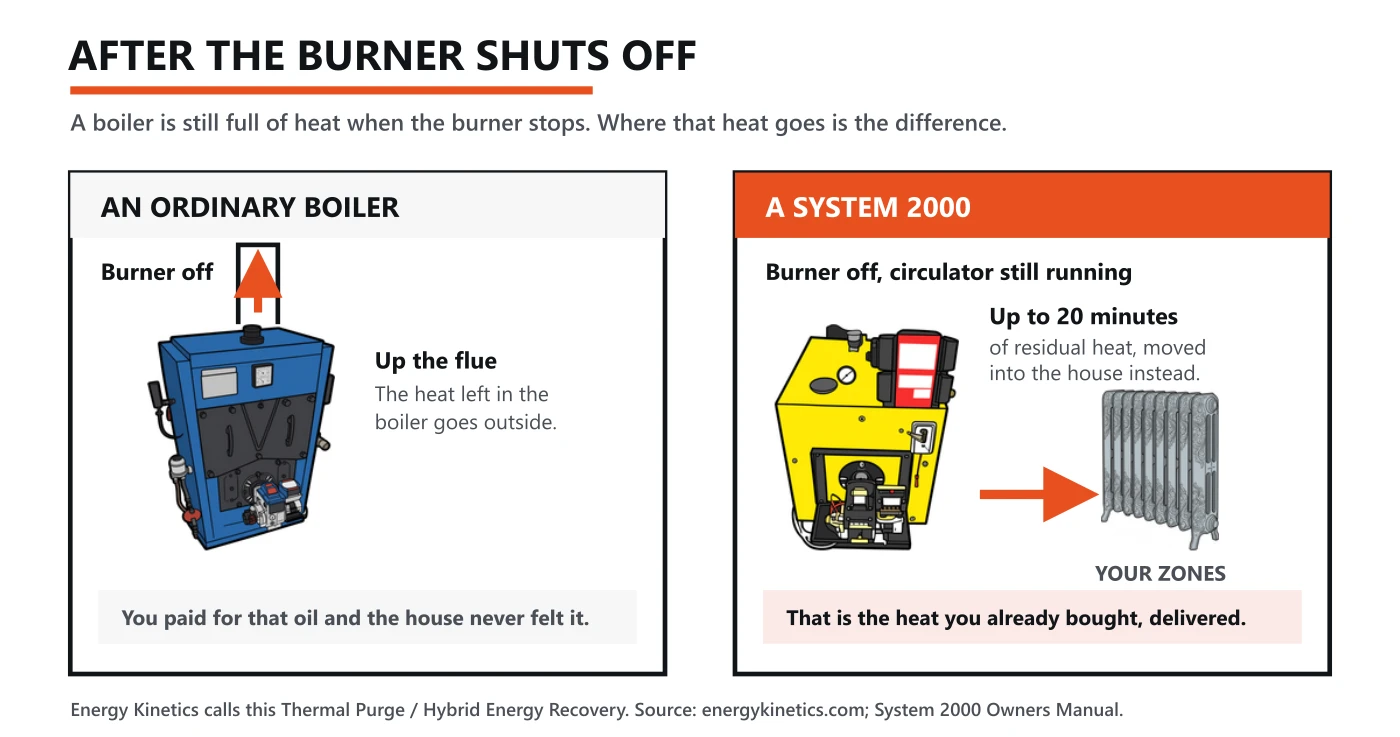
It has a very low water content (about 2.5 gallons in the EK1, 4 in the EK2), so it fires quickly, and an Energy Manager control that runs Thermal Purge / Hybrid Energy Recovery: after the burner shuts off, the circulator keeps moving residual boiler heat to the zones for up to 20 minutes instead of sending it up the flue. It combines space heat and domestic hot water under one control. Energy Kinetics has built it in Lebanon, New Jersey since 1979, and the bright yellow boiler color is a registered trademark.
Error and status codes
The Energy Manager watches boiler return temperature throughout a call for heat, so most E-codes report a heat-flow or burner problem, not a control fault.
You can do this
| Code | What it usually means | What to do |
|---|---|---|
| E140 flashing | Freeze-protection; most often a burner lockout, the flashing 140 light. |
|
Technician's job
| Code | What it usually means | What to do |
|---|---|---|
| E100 | Temperature sensor not reading. |
|
| E130 | Excess temperature; the zones cannot pull heat out of the boiler. |
|
| E150 | Return did not reach 100 F in 7 minutes; a flow restriction, not a lockout. |
|
| E190 | Reverted to cold-start operation after a persistent sensor fault. |
|
Source: Energy Kinetics System 2000 Owners & Installation Manual p.29; Energy Kinetics 140-flash troubleshooting guide
The full decoder, alongside the burner primary-control codes, is on the error-code database.
The puff switch is a combustion-chamber pressure safety wired in series with the burner. If it trips, the combustion side needs service (soot, a blocked flue, or a mistuned burner). Never bypass it. Source: System 2000 Owners Manual p.29; EK 140-flash guide; heatinghelp.com.
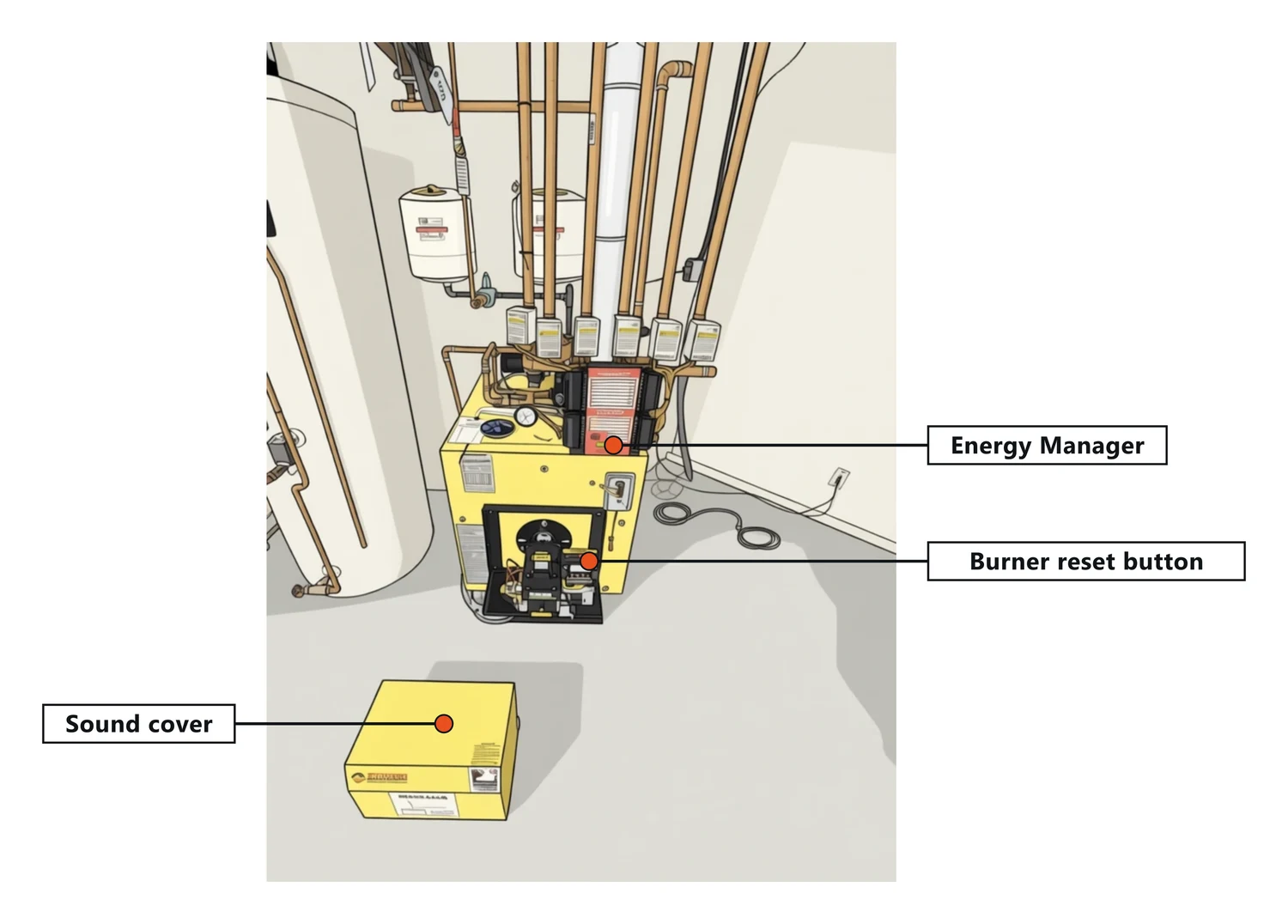
System 2000 reset button: which reset, where it is, and press it once
Owners commonly confuse two different resets:
You can do this
| Symptom | Which reset | How |
|---|---|---|
| An E-code on the manager | The Energy Manager system switch. |
|
| Burner locked out (flame failure) | The burner reset button, a separate control on the burner. |
|
Pressing a burner resetresetThe button that clears a lockout for one more ignition attempt. Press it once only, never repeatedly. more than once pumps unburned oil into a hot chamber and creates a puff-back hazard, so if the burner relocks, stop and call a technician. A System 2000 ships with a Beckett, Carlin, or Riello burner depending on the install, so the lockoutlockoutThe safety state the primary control latches into after a failed start. It stops the burner until someone presses reset. behavior is that burner’s: see the Beckett, Carlin, or Riello hub. If the burner does not even attempt a start after one reset (no motor, no hum), start with the oil furnace not kicking on checklist instead.
System 2000 troubleshooting: common problems
- Flashing 140 / E140 / burner lockout (the most common complaint, usually a flame-detection failure: dirty cad cellcad cellThe light sensor that proves a flame is burning. If it cannot see flame fast enough, the primary control locks the burner out., bad nozzlenozzleThe precision tip that atomizes oil into a fine spray for burning. It is sized by flow rate, spray angle, and pattern., oil supply (ran out of oil or air in the line), draft, or a tripped puff switch).
- Temperature-sensor failure (a periodic wear item; some owners report replacement every few years).
- Hot-water storage-tank leaks (the tank is an indirect water heater the boiler heats; replace it with the OEM Energy Kinetics tank, which does not use a standard dip tube, not a generic electric water heater).
- Plate heat-exchanger trouble: scaling or clogging on hard water (which chokes hot-water flow) and seam leaks on older units. A scale stopper helps; a clogged or leaking plate gets descaled or replaced.
- Control or relay-board failure (surge protection is recommended).
- On the Ascent, an “Err 8” on the Hydrolevel aquastataquastatOn a boiler, the control that reads water temperature to set the high limit and run the circulator. (a failed internal safety self-check) is a reported fault, sometimes heat-related; newer Ascents use a smaller, more open control cover to run the aquastat cooler.
What a System 2000 costs
Energy Kinetics does not publish list prices; a System 2000 is quoted only as an installed bundle after a contractor visit. As a rough ballpark an installed job in the Northeast generally runs in the low-to-mid tens of thousands of dollars, but the real number swings widely with the number of zones, the condition of your existing piping and chimney, old-boiler removal, and local labor rates. Treat any figure you see online as a starting point, not a quote, and get an itemized estimate. For comparison, see what a conventional oil boiler replacement runs.
Is it any good?
Owners consistently report large fuel savings, quiet operation, and long life (some original late-1970s units are reportedly still running; compare the usual oil boiler lifespan). The honest counterweight: results depend heavily on a well-trained installer, and the watch points are plate-exchanger scaling on hard water, glycol-side fouling, control and sensor wear, and using the OEM tank. It is a strong system that rewards a good install and annual service.
Keep reading
- Oil burner lockout and error codes by control
- The oil burner reset button (press once, never twice)
- What an oil furnace or boiler replacement costs
- Burner hubs: Beckett, Carlin, Riello
Parts behind an E140 lockout
Some links on this page are affiliate links: as an Amazon Associate this site earns from qualifying purchases, and it may earn from other retail partners, at no extra cost to you. Parts shown are general references, not specific endorsements. Match any part to your unit's make, model, and spec before buying.
- Oil burner nozzleAtomizes the oil into a fine spray for combustion. Check price on Amazon
- Cad cell flame sensorThe light-sensing eye that proves a flame is present. Check price on Amazon
- Burner primary controlThe brain on the burner: it runs the ignition sequence, watches the cad cell, and latches into lockout on a failed start. Check price on Amazon
- Burner motorSpins the fuel pump and the combustion-air fan on the burner. Check price on Amazon
One more part a technician reaches for on this fault, with what it does and when it gets replaced: all oil burner parts by symptom.
Sources
- Energy Kinetics System 2000 Owners & Installation Manual p.29 (ManualsLib 2398559)
- energykinetics.com (product pages, FAQ, parts trade list); ENERGY STAR listings
- Energy Kinetics 140-flash troubleshooting guide
- heatinghelp.com owner discussions