Oil heat vs gas heat: an honest comparison
Updated 18 Oct 2026
Quick answer
Neither oil heat nor gas is simply better. On running cost they are broadly comparable once oil's higher heat per gallon is factored in, and the spread swings with local prices; gas needs less routine maintenance, while oil is delivered anywhere and runs longer-lived equipment. Switching to gas only pays off when a main is already at the street and your unit is due, otherwise the connection cost swamps any savings.
On this page 6 sections
The short version
People ask “which is better” hoping for a clean answer, and the honest one is: it depends mostly on whether a natural gas main already runs to your street. If it does, gas is lower-maintenance with no tank to manage. If it does not, the cost to bring gas in (or the limits of propane) makes oil the practical choice, and a good oil system is nothing to apologize for. Here is the real comparison, without a thumb on the scale.
Side by side
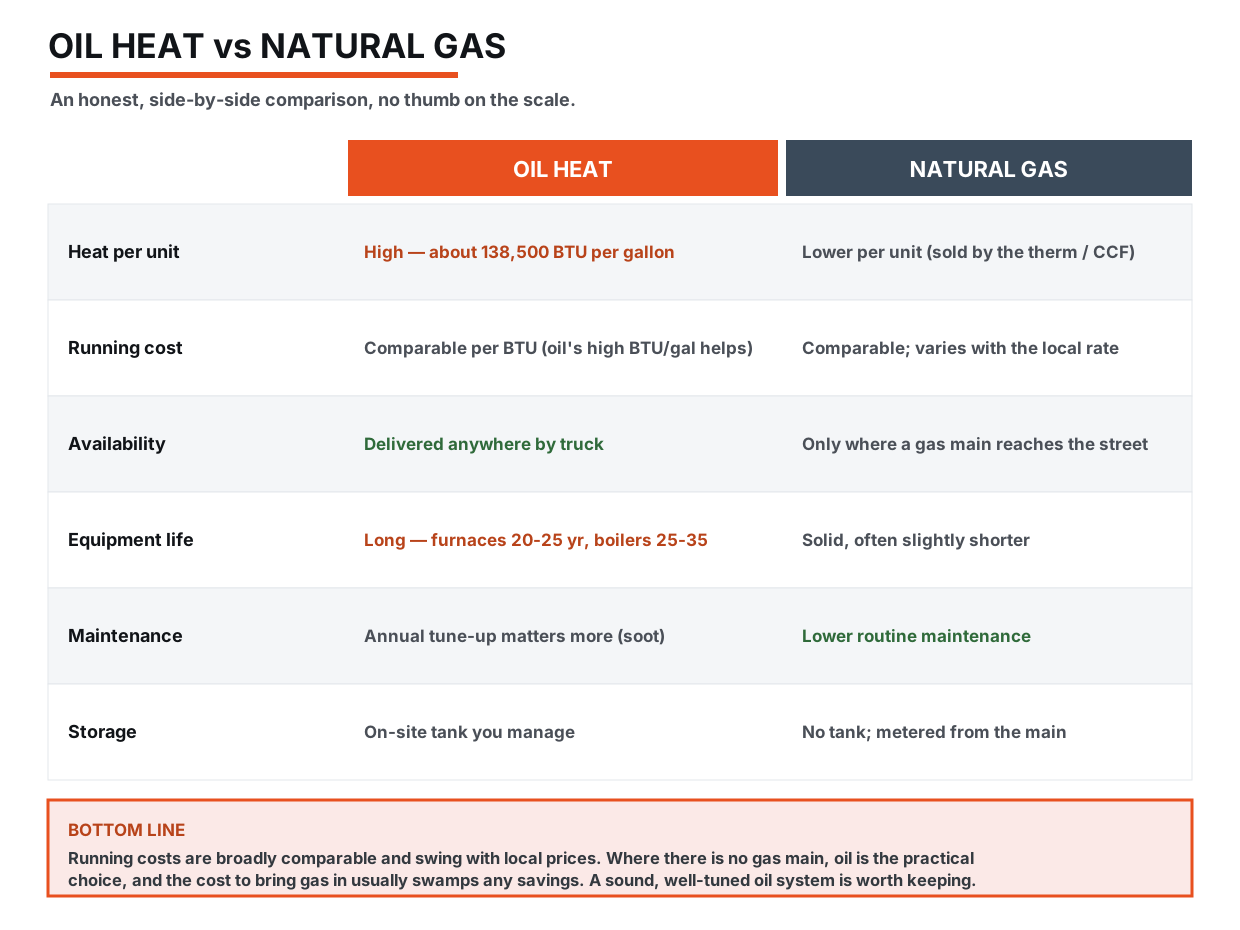
| Factor | Oil heat | Natural gas |
|---|---|---|
| Heat per unit | High: about 138,500 BTU per gallon | Lower per unit (sold by the therm/CCF) |
| Running cost | Comparable per BTU; swings with oil markets | Comparable; varies with the local rate |
| Availability | Delivered anywhere by truck | Only where a gas main reaches |
| Equipment life | Long: furnaces 20 to 25 yrs, boilers 25 to 35 | Solid, often slightly shorter |
| Maintenance | Annual tune-up matters more (soot) | Lower routine maintenance |
| Up-front to switch | n/a | Can be steep if no main is at the street |
| Storage | On-site tank you manage | No tank; metered from the main |
Cost: the honest framing
Per BTU the two are broadly comparable once oil’s higher heat content (about 138,500 BTU a gallon) is in the math, and the spread swings with oil markets and local gas rates. Two things cut against a simple “just switch to gas” assumption:
- Oil delivers more heat per unit (about 138,500 BTU a gallon), and modern oil equipment is efficient, so the gap is smaller than the per-unit prices suggest. Run your own numbers with the oil usage estimator rather than trusting a rule of thumb.
- The switch itself costs money. Converting from oil to gas means a new gas line from the street (if a main is even there), a new furnace or boiler, and abandoning the oil tank. Where there is no main, the cost to extend one can run into many thousands, which a fuel-price difference takes a very long time to repay.
So the cost answer is: running costs are close and depend on your market and local rates, and where there is no gas main, oil is the clear practical choice because the connection cost dominates the total.
The other factors
- Maintenance. Oil leaves combustion residue, so the annual tune-up matters more than it does for gas. Budget for it; it is also what gets oil equipment to its long lifespan.
- Equipment life. Oil boilers in particular are famously long-lived, which spreads the cost of the unit over more years.
- Safety. Both are safe when maintained. Oil will not explode the way a gas leak can, but a neglected oil burner can soot, puff back, or make carbon monoxide. Both deserve CO detectors.
- Control and supply. With oil you manage a tank and deliveries (auto-delivery removes most of that friction). With gas you are metered and never think about it, but you are also tied to the utility.
What about a heat pump?
A cold-climate heat pump is the third option people weigh, and it is a real one, especially as a supplement. It is electric, efficient, and adds cooling, but its economics swing on your electricity price and how cold your winters get, and a backup heat source is common in the coldest zones. It is a bigger decision than a fuel swap and worth its own quotes.
The bottom line
Do not switch fuels for a small per-BTU saving alone. Switch to gas only if a main is already at the street and your oil equipment is due for replacement anyway, and even then it is more about convenience than big savings. Stay with oil if there is no gas main, or your system is sound, and put your money into keeping it tuned. If your current unit is near end of life either way, start with the replacement cost guide and get itemized quotes for each path.
Sources
- U.S. EIA residential energy and heating fuel price data
- Manufacturer efficiency (AFUE) literature for oil and gas equipment