Oil furnace replacement cost: new furnace and boiler prices
Updated 18 Oct 2026
Quick answer
Oil furnace replacement cost typically runs about $8,000 to $14,000 installed in 2026; oil boilers cost more, about $10,000 to $21,000, and add-ons (chimney liner, tank, oil lines, controls) move the number more than the brand does. Get itemized quotes, the install quality matters more to your fuel bill than the nameplate.
On this page 7 sections
The number everyone wants first
Honest installed-price bands for 2026, meaning equipment plus a competent install, before the add-ons below. Prices drift, and for years they have only gone up, so treat these as ranges to sanity-check a quote against, not promises.
- Oil furnace (warm air) swap: roughly $8,000 to $14,000 installed.
- Oil boiler (hot water) swap: roughly $10,000 to $21,000 installed. A boiler with a built-in hot-water coil sits at the low end; a high-efficiency boiler with a separate indirect water heater sits at the top.
- With a new tank in the same job: add roughly $4,000 to $7,000 (see the tank replacement guide).
Ask every contractor for a full written scope of work that lists what is included. Two quotes for the same job can cover very different work: some installers reuse the old parts and others replace them, and some skip the valves. Valves add expense up front but save on repairs later. Compare the scopes line by line, not just the totals.
What moves a job between bands is rarely the brand. It is the add-ons: a chimney that needs a stainless liner, oil lines and a filter and a fire valve brought to code, new controls, and whether the old equipment is a clean swap or a fight to get out of the basement.
Furnace or boiler: you are replacing what you have
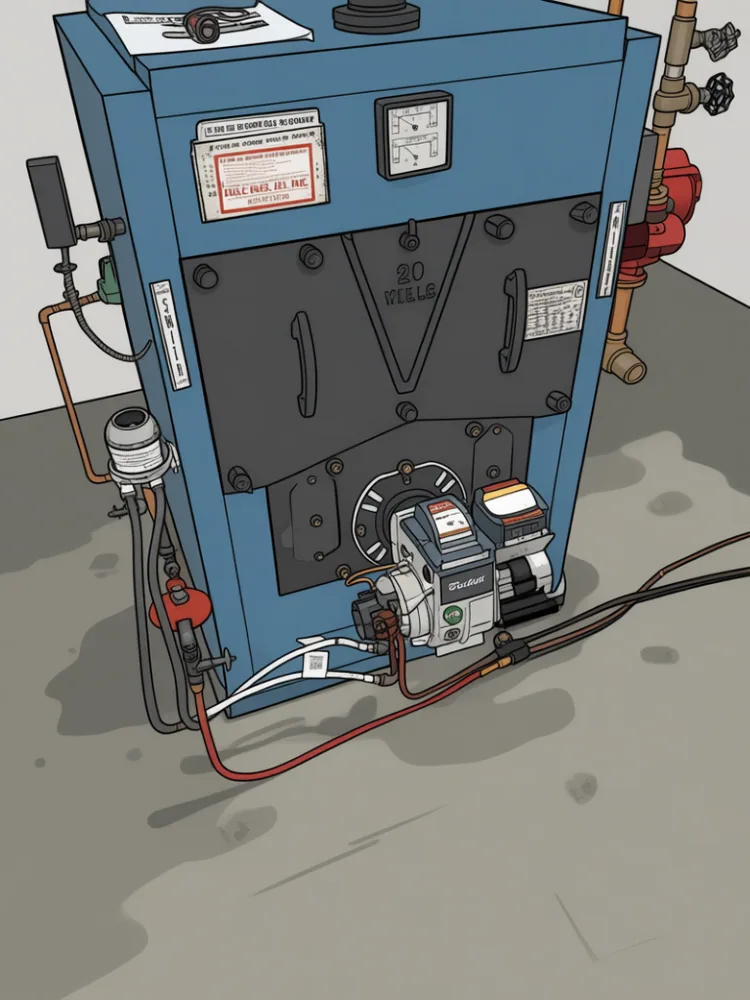
- A furnace heats air and blows it through ducts. A boiler heats water for baseboard, radiators, or radiant. They are not interchangeable; you replace like with like unless you are re-doing the whole distribution system.
- Switching fuels (oil to gas, or to a heat pump) is a different project with its own math and is not what these numbers cover.
What a proper install includes
A quote that is only a box price is missing the work that determines whether the new unit actually saves you money:
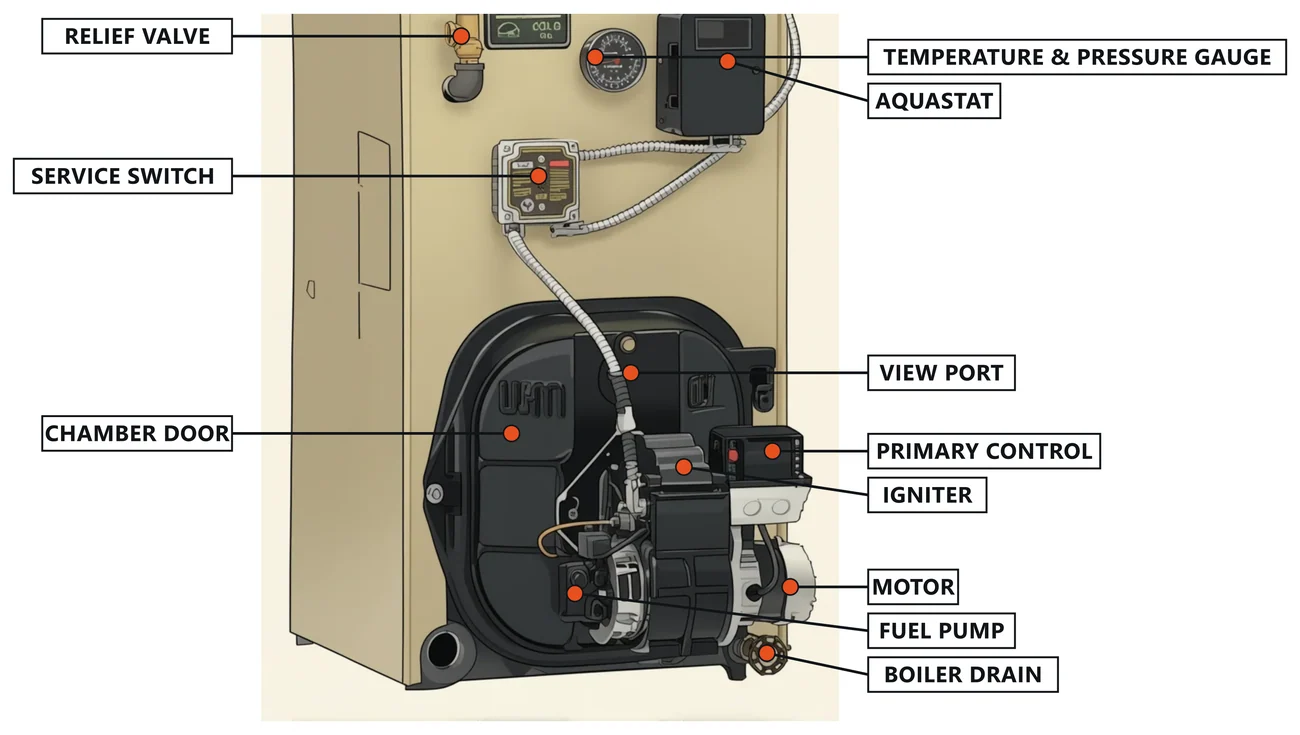
- A heat-loss calculation (a Manual J or equivalent), not square-foot guessing, so the unit is sized to the house. Oversizing is the most common and most expensive sizing error.
- A chimney and flue assessment, including a stainless liner if the old one is oversized or deteriorated.
- A new oil line, filter, and fire valve, and a barometric damper set with a draft gauge.
- Controls wired correctly, and a commissioning combustion testcombustion analyzerThe instrument a technician uses to read the flue gases and tune the burner to spec. The part of a tune-up that cannot be eyeballed. with the numbers left with you (smoke, draftdraftThe suction the chimney pulls through the burner. Too much or too little shows up as sooting, odor, or lost efficiency., CO2 or O2, stack temperature, efficiency).
- The permit and inspection where your jurisdiction requires it (NFPA 31NFPA 31The national standard for installing oil-burning equipment. Most oil-heat install and safety rules trace back to it. and local code).
Efficiency tiers and the payback math
Oil furnaces and boilers are rated by AFUE (annual fuel use efficiency). Older units run in the low-to-mid 80s; new units run mid-80s to low-90s. The honest way to see the payback is gallons, not percentages. No. 2 oil holds about 138,500 BTU per gallon (EIA), so:
- A home burning 800 gallons a year at 82% AFUE is delivering about 800 x 0.82 = 656 gallons-worth of heat into the house.
- To deliver that same heat at 87% AFUE takes about 656 / 0.87 = 754 gallons, a saving of roughly 46 gallons a year. At, say, $4.00 a gallon that is about $184 a year.
So a five-point AFUE jump on an average home saves on the order of $150 to $250 a year at recent prices, which pays back the efficiency premium (not the whole furnace) over many years. Replace because the old unit is failing or unsafe; treat the efficiency gain as a bonus, not the reason. Our oil usage estimator runs your own gallons, and the lifespan guide covers when a unit is genuinely done.
When repair beats replacement
A rough rule, then judgment:
- Cracked heat exchangerheat exchangerThe metal chamber that passes combustion heat into your home's air or water while keeping the fumes separate. A crack in it is a carbon monoxide hazard., or a rotted boiler section: replace. A crack is a carbon monoxide path, and it is not a repair.
- Control, pump, nozzlenozzleThe precision tip that atomizes oil into a fine spray for burning. It is sized by flow rate, spray angle, and pattern., igniterigniterThe modern solid-state replacement for the ignition transformer, doing the same job of firing the spark., cad cellcad cellThe light sensor that proves a flame is burning. If it cannot see flame fast enough, the primary control locks the burner out.: repair. These are cheap parts on an otherwise sound unit (see troubleshooting).
- A $500 repair on a 25- to 30-year unit that has needed something every winter is the classic case to put the money toward replacement instead.
Reading quotes: the red-flag list
- Square-footage-only sizing with no heat-loss calculation.
- No combustion numbers promised at commissioning.
- The tank ignored on an old system that clearly needs one.
- “While we’re here” upsells with no itemization.
- A lowball with no breakout, which usually means the liner, oil line, or permit got left out and will reappear as a change order.
Get two or three itemized quotes, compare the line items, not just the totals, and ask each contractor what combustion numbers they will leave behind.
Timing and money notes
- Off-season (late spring through summer) is when prices are softest and lead times shortest; an emergency January replacement is the most expensive way to buy one.
- Rebates and financing for high-efficiency equipment come and go by state and utility; ask, but do not let a rebate drive an oversized or wrong-fuel choice.
Sources
- Manufacturer literature (Thermo Pride, Williamson, Buderus/Bosch, Energy Kinetics)
- U.S. EIA heating fuel and efficiency data (No. 2 oil ~138,500 BTU/gal)
- NFPA 31: Standard for the Installation of Oil-Burning Equipment
- Installer quotes for oil heating replacements, Northeast, 2026