Barometric damper: what the draft regulator does
Updated 18 Oct 2026
Quick answer
A barometric damper is the hinged, counterweighted flap in the flue that holds the chimney's draft steady by letting room air in when the chimney pulls too hard. Steady draft is what keeps an oil burner clean and efficient, so a stuck or mis-set damper shows up as sooting, odor, or wasted fuel. Setting it correctly takes a draft gauge, which makes it technician work.
On this page 6 sections
Some links on this page are affiliate links: as an Amazon Associate this site earns from qualifying purchases, and it may earn from other retail partners, at no extra cost to you. Parts shown are general references, not specific endorsements. Match any part to your unit's make, model, and spec before buying.
What it is
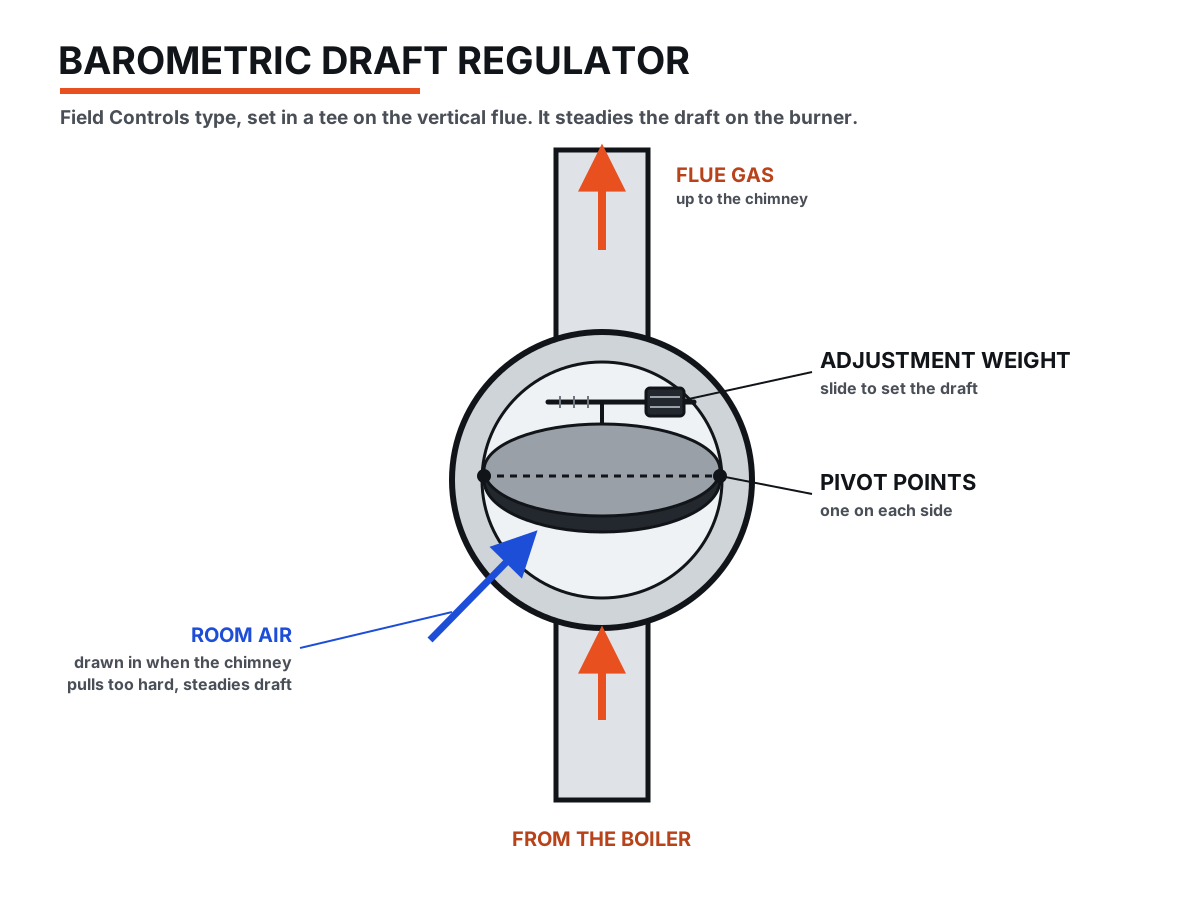
A barometric damperbarometric damperThe hinged flue damper that steadies draft over the burner by letting in room air when the chimney pulls too hard., also called a draftdraftThe suction the chimney pulls through the burner. Too much or too little shows up as sooting, odor, or lost efficiency. regulator, is the round, hinged flap you see set into the flue pipe between an oil furnace or boiler and the chimney (for where the flue sits in how the whole oil system works, start there). It is a deceptively simple part: a counterweighted door that swings open and closed on its own to keep the draft over the burner steady, no matter what the chimney is doing.
Why you’d want one (you almost certainly have one)
Oil burners are tuned to run in a narrow draft band, roughly a few hundredths of an inch of water column of suction over the fire. The trouble is that a chimney’s pull is not constant: it gets stronger in cold, windy weather and weaker in mild weather, so without regulation the draft would swing all over that band. The damper fixes that:
- It saves fuel. Too much draft (over-draft) pulls heat straight up the chimney before it can transfer into the house, and pulls extra air through the fire that cools the flame (bad draft is one of the causes behind a burner that fires then shuts off). A damper caps the draft so more of the heat stays in the heat exchangerheat exchangerThe metal chamber that passes combustion heat into your home's air or water while keeping the fumes separate. A crack in it is a carbon monoxide hazard..
- It prevents soot and odor. Unstable draft makes an unstable fire, which burns sooty and smelly. Steady draft is half of a clean burn (the nozzlenozzleThe precision tip that atomizes oil into a fine spray for burning. It is sized by flow rate, spray angle, and pattern. and air setting are the other half).
- It is usually required. NFPA 31NFPA 31The national standard for installing oil-burning equipment. Most oil-heat install and safety rules trace back to it. and burner manufacturers call for draft control on oil equipment, so this is less an upgrade than a part you keep working. The “upgrade” is usually replacing a stuck or wrong-size one, or adding one a previous install skipped.
How it works
The damper is just physics. A balanced flap hangs in the flue with an adjustable counterweight on the outside:
- The chimney pulls a suction (draft) on the flue.
- When that suction exceeds what the counterweight is set to hold, it pulls the flap open, letting room air into the flue.
- That room air satisfies part of the chimney’s pull, so the suction over the burner drops back to the set value.
- As the chimney’s pull eases, the counterweight swings the flap closed again.
Slide the counterweight out and the damper opens at a lower draft (less suction over the fire); slide it in and it holds more. That single adjustment is what a technician sets, and it is why the setting matters as much as the part.
Setting it with a draft gauge (and installing it)
Replacing or adding a barometric damper is flue work tied directly to combustion:
- It mounts in the breeching (the horizontal flue pipe) or a tee, sized to the pipe diameter, with clearance for the flap to swing and the face roughly vertical.
- After it is in, the draft is set with a draft gauge (a manometer) while the burner runs, to the burner manufacturer’s spec, then confirmed with a combustion testcombustion analyzerThe instrument a technician uses to read the flue gases and tune the burner to spec. The part of a tune-up that cannot be eyeballed..
The disclaimer. This is the part people most often get wrong by eye. A damper set too tight starves the fire (incomplete combustion, soot, and carbon monoxide); set too loose it wastes fuel and can let the burner cycle on draft. You cannot set it correctly without a combustion analyzer and a draft gauge, which is why the setting is technician work even though the part is cheap. Swapping a seized damper for the same size is within reach of a capable DIYer; setting the draft afterward is the visit. NFPA 31 and your burner’s instructions govern it. Never wire, weight, or block a damper shut to “improve” anything, that defeats its purpose and makes an unsafe fire.
Troubleshooting a draft damper
- Soot or odor that started recently: a damper stuck closed (it cannot admit relief air, so draft over the fire runs too high and pulls heat up the stack) or stuck open (room air floods the flue, so draft over the fire goes weak and the chimney cools) can both show up as a dirty or smelly fire. Check that the flap swings freely; have the draft re-set.
- Rattling or chattering: an unbalanced or undersized flap, or strong wind at the chimney top.
- The flap fell out or is wrong size: common after a flue change. Size it to the pipe and set the draft.
Any of these is a reason to have the draft measured, not to eyeball the flap.
Tools for the job
Some links on this page are affiliate links: as an Amazon Associate this site earns from qualifying purchases, and it may earn from other retail partners, at no extra cost to you. Parts shown are general references, not specific endorsements. Match any part to your unit's make, model, and spec before buying.
The damper itself is in the parts box below, sized to your flue pipe diameter (commonly 5, 6, or 7 inch). The one tool that makes it more than a guess is a draft gauge (manometer) (search Amazon); without it you are setting the most important number on the burner by feel, so most people leave the final setting to the tune-up.
Frequently asked questions
What does a barometric damper do?
It holds the draft over an oil burner steady by swinging open to admit room air whenever the chimney pulls harder than the burner needs. Steady draft keeps the fire clean and efficient, so the damper protects against sooting, odor, and wasted fuel.
How is a barometric damper set?
A technician runs the burner and measures the draft with a draft gauge, then slides the damper's counterweight until the suction over the fire matches the burner manufacturer's spec, and confirms it with a combustion test. It cannot be set accurately by eye.
Can I adjust the damper myself?
You can see the counterweight and the flap, but setting it without a draft gauge means guessing at the single most important combustion number, and too tight makes carbon monoxide. Inspecting that the flap swings freely is fine; setting the draft is a job for the tune-up.
Do I really need one?
Oil equipment is designed to run with draft control, and NFPA 31 and burner makers call for it, so yes. If yours is missing, stuck, or the wrong size, that is a real and common cause of soot and high fuel use.
What to buy
Some links on this page are affiliate links: as an Amazon Associate this site earns from qualifying purchases, and it may earn from other retail partners, at no extra cost to you. Parts shown are general references, not specific endorsements. Match any part to your unit's make, model, and spec before buying.
Barometric draft damper
The hinged flue damper that stabilizes draft over the burner. Set wrong or stuck, it shows up as soot or odor.
Replace it when: It is stuck, rattling, or the wrong size after a flue change.
Often replaced at the same visit: nozzle
Barometric draft damper: how it works and what to buy →
Sources
- Field Controls barometric draft regulator literature
- R.W. Beckett and NORA combustion-and-draft guidance
- NFPA 31: Standard for the Installation of Oil-Burning Equipment