Ran out of heating oil? Here's the order of operations
Updated 18 Oct 2026
Quick answer
Running out of heating oil won't damage the system, but it usually airlocks the fuel line and stirs tank sludge into the filter. Stopgap: 5 to 10 gallons of clear (on-road) diesel or kerosene from any gas station, poured into the fill pipe, left to settle 30 minutes, then ONE reset press. If it won't stay running, the line is airlocked and needs bleeding. This guide explains how, but that work puts pressurized fuel and a live burner in play.
On this page 7 sections
Don’t panic: what running dry does, and does not, hurt
Running out of oil does not by itself damage the furnace. The problems it causes are two: it pulls air into the fuel line, which then airlocks and will not feed the pump, and it stirs up the sludge that settles on the tank bottom, sending it toward the pickup and the filter. So a restart after a run-out is not always a simple resetresetThe button that clears a lockout for one more ignition attempt. Press it once only, never repeatedly., and that is normal.
The diesel or kerosene stopgap, step by step
If a delivery is hours or a day away and the house is getting cold, you can buy time with fuel from a gas station. Heating oil is No. 2 distillate, the same family as on-road diesel, so clear diesel burns in an oil furnace as a short-term bridge. K-1 kerosene works too.
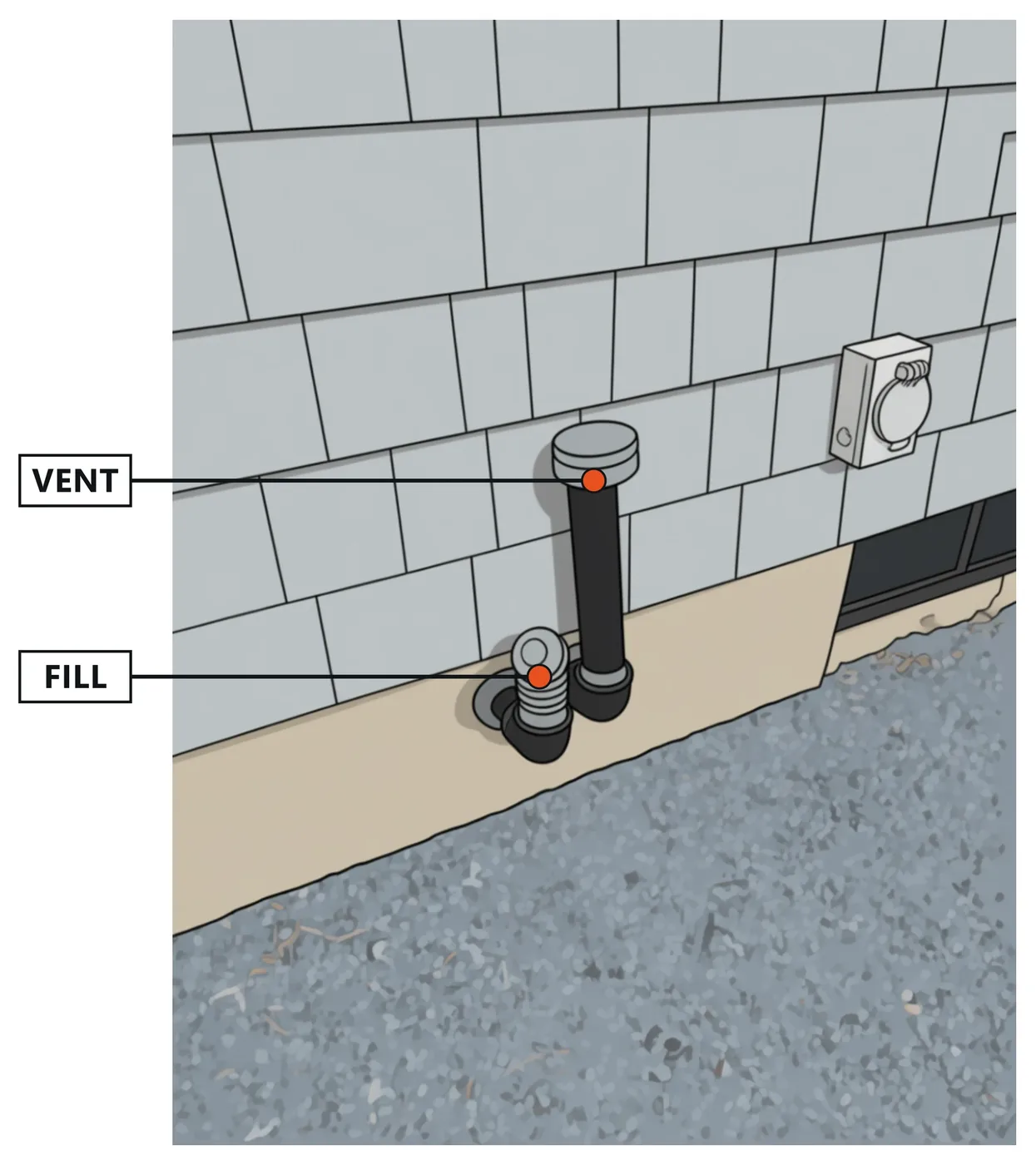
- Buy 5 to 10 gallons of clear (on-road) diesel or kerosene in a clean approved can. Avoid dyed off-road diesel if you can, and never gasoline, gasoline in an oil burner is dangerous and a fire risk.
- Pour it into the tank fill pipe (the larger of the two pipes outside), not the vent.
- Let it settle for at least 30 minutes so it reaches the pickup and any stirred sediment has a chance to drop.
- Set the thermostat to call for heat and press the reset button once.
The diesel is a bridge, not a fix. It costs far more per gallon than delivered heating oil, so add just enough to get to your delivery, then fill the tank properly.
Restarting: one press, then read the result
After the settle, with the thermostat calling, press reset one time and watch:
- Starts and runs clean: good. Stay with it for a full cycle, then order oil.
- Starts, sputters, and dies, or locks out again: the line is airlocked. Stop pressing. More resets just spray unburned oil and risk a puffbackpuffbackA sudden ignition of oil that pooled after failed starts. It can blow the flue apart and coat a house in oily soot, which is why you never stack resets. (the reset button guide explains why). The line needs to be bled, which is the next section.
Bleeding the line: how it is done, and the hazards
This is the step that gets a run-out burner firing again, and the information is all over YouTube and the trade manuals, so here is what it actually involves. Read the warning first: bleedingbleedPurging air from the oil line at the pump's bleed port so the burner can draw fuel again, usually after a run-out. puts pressurized fuel oil and a running burner in play at the same time. If that combination is not something you are set up to handle safely, this is a quick, often free job for the delivery driver or a technician, skip to the next section and let them do it.
First, which system do you have? Look, do not disconnect anything. A single pipesingle pipeAn oil supply setup with one line from the tank to the burner pump. Simple, but it can trap air after a run-out, which is why a de-aerator helps. running from the tank to the pump airlocks after a dry run and has to be bled. A two pipe system, or one fitted with a Tigerloopde-aeratorA small device that removes air from the oil line so a single-pipe system self-bleeds instead of locking out. Tigerloop is the common brand. de-aerator, usually purges its own air and may restart without bleeding.
How the bleed is done on a single-pipe pump:
- The bleed port is a hex nipple or small valve on the body of the fuel pump (Suntec and Webster are the common makes), usually taking a 3/8 inch or 7/16 inch wrench. A clear hose slipped over it runs the purge into a glass jar or a clear container so you can see when the air is gone.
- With the thermostat calling and the bleed hose in the container, the burner is started and the bleed screw is cracked open about half a turn while the pump runs. Oil, foam, and air spit out into the container.
- It is left open until the stream runs steady and bubble-free, usually several seconds to a half a minute, then the screw is closed snug before the control times out.
- The fuel filter gets changed afterward (a run-out drags sludge into it), and every fitting touched is checked for weeping once the burner is running clean.
The hazards, plainly. The oil leaving the bleed port is under pump pressure, so eye protection and rags are not optional, and it makes a flammable mess. The burner is firing during the bleed, which means you are racing its 15 to 45 second trial window: if it locks out, you are back to the one reset only rule, never stack attempts to “get it” (that is the puffback risk again). Hot surfaces, fuel, and electricity are all present at once. None of that is a reason the job cannot be understood, it is the reason to decide honestly whether to do it or hand it to a pro. Codes (NFPA 31NFPA 31The national standard for installing oil-burning equipment. Most oil-heat install and safety rules trace back to it.) and your burner manufacturer’s own instructions govern the work; if your owner manual documents a bleed procedure for your exact unit, that document is the authority over any website. Proceed at your own risk or call a pro.
The one line this guide will not cross: nothing here defeats a safety control. Bleeding clears air, it does not bypass the cad cellcad cellThe light sensor that proves a flame is burning. If it cannot see flame fast enough, the primary control locks the burner out., the primary controlprimary controlThe small box on the burner that runs the ignition sequence, watches the cad cell, and latches into lockout on a failed start., or any limit. If a restart only works by jumping or fooling a safety, the burner is telling you to stop and call.
Ordering oil after a run-out
- Tell the dealer it ran dry. They will plan to primeprimeGetting oil flowing through the pump and out the nozzle on a dry or air-bound line, done at the pump's bleed port. and bleed the line, which changes how they schedule and what they bring.
- Emergency vs will-call. An after-hours emergency delivery costs more than a scheduled one; if the diesel stopgap is holding, a next-day delivery may save money.
- How much to order. Do not order the minimum. Filling the tank dilutes any remaining sludge and gets you past the next cold stretch.
How to never run dry again
- Stick the tank weekly in winter and convert with the tank chart; do not trust the float gauge, they stick.
- Ask about automatic delivery. The dealer estimates your usage (a K-factorK-factorA home's degree-days per gallon of oil burned. Dealers use it to predict when you will need a delivery. based on degree-daysdegree-dayA measure of how cold a day was: how many degrees the average temperature fell below 65 F. More degree-days means more oil burned.) and tops you off before you get low, so a forgotten will-call never becomes a 6 a.m. run-out. Our oil usage estimator shows the same math.
- Keep the tank above a quarter in winter. Low tanks both run out sooner and feed the most sludge into the system. A repeat airlock problem is also the classic case for a Tigerloop de-aerator.
Parts behind this fault
Some links on this page are affiliate links: as an Amazon Associate this site earns from qualifying purchases, and it may earn from other retail partners, at no extra cost to you. Parts shown are general references, not specific endorsements. Match any part to your unit's make, model, and spec before buying.
- Oil absorbent padsA sheet of oil-only sorbent laid under the burner, filter, and pump. Check price on Amazon
- Oil filter and cartridgeCatches sludge and water before they reach the pump and nozzle. Check price on Amazon
- Fuel oil de-aeratorPurges air from the oil line so a one-pipe system self-bleeds after a run-out instead of locking out on air. Check price on Amazon
- Flexible oil linesThe flexible flare-ended lines that connect the burner (or a de-aerator) to the rigid oil line, so the burner can be swung open for service without unmaking fittings. Check price on Amazon
One more part a technician reaches for on this fault, with what it does and when it gets replaced: all oil burner parts by symptom.
Sources
- U.S. EIA heating fuels documentation (No. 2 distillate equivalence)
- Suntec / Webster fuel unit (oil pump) bleed-port documentation
- NFPA 31: Standard for the Installation of Oil-Burning Equipment